
I quit Spotify—now I buy albums like it's the 90s
We're renting our music and platforms instead of owning them. New internet platforms want to change that.

This essay is for Internet Sovereignty, nine writers exploring the future of the internet through an online essay series and print pamphlet. Support the collection by collecting the digital or print edition. 👇🏻
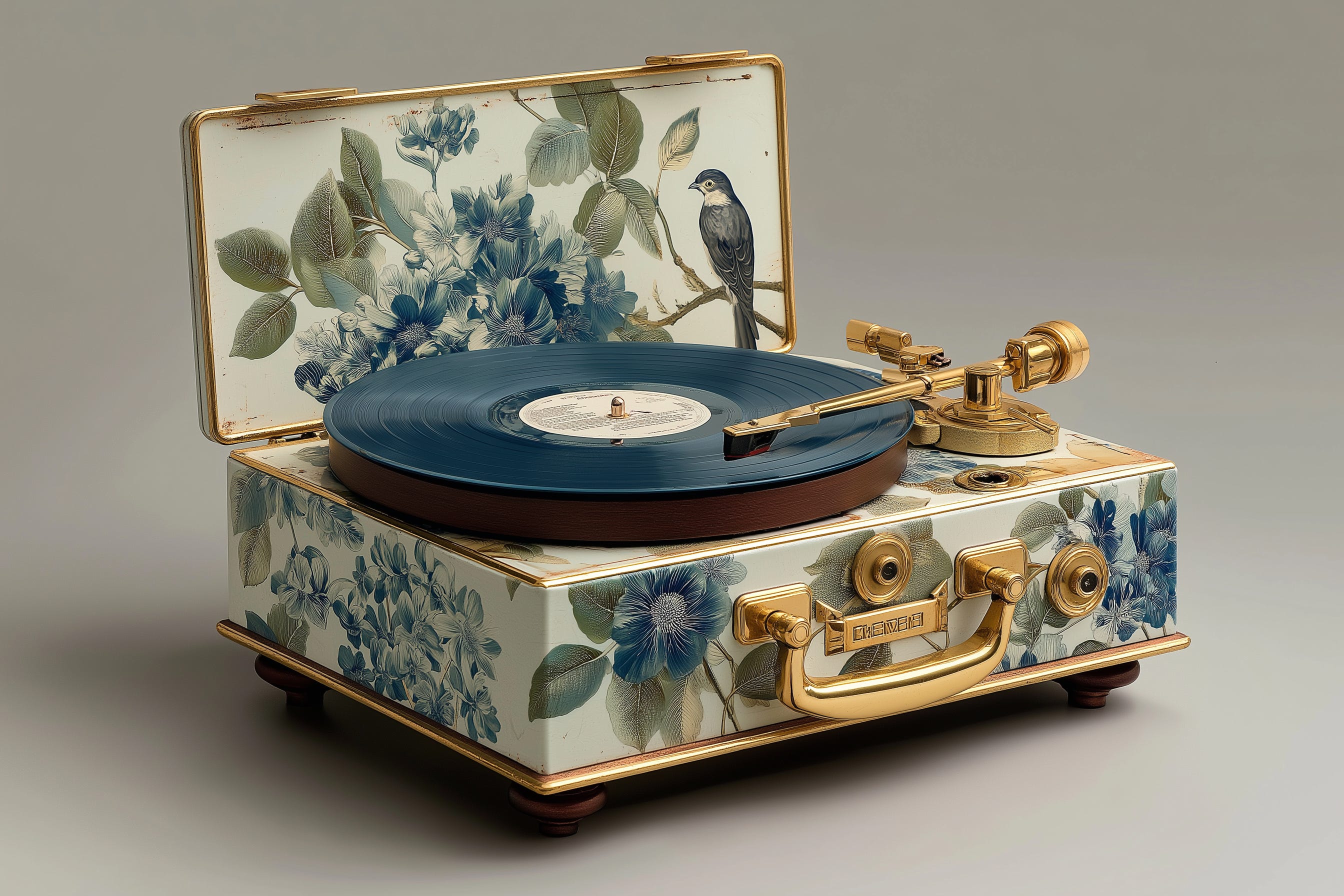
In high school, I had Backstreet Boys posters all over my room and a stereo with a three-disc changer that played their albums on repeat—friends would browse my CD sleeve when they came over for a slumber party.
The iPod came out when I was in college, and we’d buy songs directly on iTunes. Listening to someone else’s iPod was to travel through their tastes and interests. We plugged headphones into the aux jack to listen with friends, and burned playlists onto CDs for each other.
Then Spotify came along, and we bought subscriptions instead.
We no longer pay directly for the music we love; we pay the platform for unlimited access to all of it. Our libraries are no longer the albums we bought and curated, but also the playlists Spotify curated for us.
There can be no doubt that platforms like Spotify expanded the reach of MTV’s TRL and the limited libraries in our CD sleeves. But they broke our relationship with the artist in the process. Now we have a relationship with a platform that controls what music we see and which artists it surfaces. By inserting themselves into the middle of that transaction, content aggregators now make much more money than the creators of it do.
And investors in the company earn more than everyone.
There are movements to realign platform incentives with the artists who create them and the fans who support them. Customers, once again, want to buy directly from the artists they love, and artists and fans want to be the beneficiaries of the companies that host them. The platform shouldn’t be the product; the art that lives on it should be. And the beneficiaries of the platform’s success shouldn’t just be a bunch of investors, but also the artists and fans who created it.
Companies are already building that future.
Spotify / Platform Economy
The advent of streaming fundamentally altered how musicians make money.
For a musician to earn $100,000 from their craft, they’d only need to sell 15,385 albums (at roughly $6.50 per album), but on Spotify, they’d need 25 million streams (at roughly $0.004 per stream). That’s if they are independent. If a major record label holds the rights, the label keeps 85%—now the musician needs to sell 102,564 albums or reach 167 million streams, with the hope that the label will provide some aid in reaching those numbers.
Looking at that math, we can see that it is by far more beneficial for artists to sell albums directly to fans than hope for streams. And that is, by far, more beneficial for artists to remain independent than go with a label.
If, that is, fans can find them.
Discoverability is the hope of the platform economy, but it comes at a cost. On Spotify, Discovery Mode lets artists opt into a lower streaming fee in exchange for getting their songs into playlists and on autoplay. As a result, Spotify’s algorithm prioritizes music for which it pays the least.
Spotify also pays 70% of its revenues to music rights holders, which makes it more profitable to prioritize content they own the rights to, like podcasts it has purchased outright. As a result, podcasts and playlists became the only things recommended in my feed, despite the fact that I never used Spotify to listen to podcasts and rarely listened to playlists. I’m an album listener.
Where we once purchased our favorite music directly, now we’re shuffled into playlists where we might not even know who we’re listening to. We’ve become passive listeners of playlists Spotify has quite a lot of leverage over. Any direct contact musician once had with fans disappeared when Spotify removed the notification bell from artists’ profiles. “Following” an artist on Spotify no longer means “tell me when an artist I love announces a new album or tour.” It means “add this data point to my profile so Spotify can better serve me content.”
The platform captures the value of the relationship while artists bear the production costs.
Certain musicians even get more airtime than others depending on their salability. Spotify uses localized pricing—a premium subscription might cost $10.99/month in the US but under $2/month in Nigeria, and since royalties are calculated as a percentage of customer revenue, a stream from a Nigerian customer pays the artist significantly less than a stream from a US customer, as low as $0.0003–0.001 per stream. Spotify thus has a geographic bias, pushing music that appeals to US and European listeners because those listeners will pay more.
Not only do artists with fanbases outside the Eurosphere earn less, but their music may also be less likely to get surfaced to new listeners because it’s less profitable to the platform. This can make it much more difficult to earn streams, the Nigerian musician Lindsey Abudei told me. “That’s why tours are good for the artists,” she said. “Because you can go to a territory where the subscription fees are higher, and if you have more people streaming in that area, then you earn more money.”
It’s not just Spotify. We saw a similar effect play out on Medium, where readers can subscribe to the platform and access an abundance of writers, but writers like me were subject to the whims of the algorithm, which rewarded only the most viral posts—usually clickbait about how to make money as a writer. Those are the posts that made Medium money, so those are the kind of posts writers write to make money. I had no control over who saw my work in their feed; even those who “followed” me weren’t guaranteed to see it. They merely saw “writers like me,” the algorithm deemed most profitable.
As on Spotify, the platform is the product being sold, not the art we were putting on it.
Actually, at Spotify, the product is the value of the company.
The more we listen to music on Spotify, the more the value of the company goes up, and that benefits founders, industry executives, and investors who hold stock in the company, not the musicians who are providing what we’re all paying for. When Spotify launched in the US, the three largest labels received a combined 18% ownership stake, netting them hundreds of millions of dollars and preferred placement on Spotify’s playlists. It no longer matters whether any particular artist gets more streams; the labels will profit from Spotify’s collective valuation regardless.
As someone who loves and spends money on music, this frustrates me. I want my dollars to go directly to the artists I’m listening to, not all the industry execs who have inserted themselves in the middle. I canceled my Spotify subscription two years ago and started purchasing the albums I love directly on iTunes. Now, my Apple Music app functions like an old iPod, and the amount I used to pay for a subscription—roughly $12 a month—goes directly to the artists I like, not to the platform they’re on.
I’m not the only one interested in a change. The platform economy is slowly evolving into an even better creator economy, a growing movement to pay artists directly.
Bandcamp / Creator Economy
Bandcamp debuted as an alternative to Spotify, allowing artists to upload their music and earn sales directly from fans who want to purchase their music and merchandise. Here, artists set their own prices and keep 80-90% of their earnings, while the platform takes only 10-20% of artist sales.
That’s why the musician Abudei prefers it to Spotify. “One of the reasons why people like Bandcamp is that you can sell your album, you can sell vinyl and t-shirts and zines and stickers,” she told me. “The physical is important. There is a subtle awareness about the internet and how fickle it is. People want to collect the physical.”
There is no algorithm deciding what music enthusiasts see; they are there to purchase albums and listen to them. And unlike Spotify’s nebulous “follows,” artists have direct access to their fans. “When you sell an album on Bandcamp, you can track your supporters and see them on your profile,” Abudei told me. “Bandcamp also has an app where artists can manage messaging—if you want to send messages to people who have supported your music or have bought albums, you can do that. If someone buys your album, you can send them a thank you.”
This is a much better transaction, and a wave of “creator economy” platforms has followed a similar model. Substack, for instance, allows writers like me to publish my writing directly to my subscribers without hoping the platform will algorithmically surface my work. Readers pay me directly, not the platform, and the platform keeps only 10% of my earnings, rather than the bulk. And if I ever leave the platform, I can take my readers with me by downloading my subscriber list. Metalabel and Patreon work similarly.
These platforms do an incredible job at solving the first half of the problem: Removing the middleman standing between the creator and the user. Our money goes directly to the people we support, not a subscription to the platform, and that’s much better!
But they don’t solve the second half of the problem: That the platform itself is not owned by those who make it successful. Bandcamp, after all, started out the way most startups do: With investors expecting returns from a future exit event. The company was sold to Epic Games in 2022, which sold it to Songtradr in 2023, and those transactions caused huge windfalls for the company’s founders, investors, and Epic Games, but not for artists. Roughly half of the company’s employees were laid off, including those who attempted to unionize under Epic.
I know that Substack will eventually go this way, too. With all their funding, they will have to head toward an exit event, which will mean an eventual landslide for Andreessen Horowitz even as writers contribute all the work that made it successful. I appreciate the inroads they’ve made here—Substack raised a community round that I invested in which means, as a writer, I will benefit if there is eventually a sale, and that is a step in the right direction. Airbnb did something similar when it went public, inviting a small subset of Airbnb hosts to buy stock before trading began. We should align incentives so that platform users want the platform to succeed as much as investors do.
There can be no doubt, however, that SEC regulations make it difficult to do much more than that, and each platform’s top investors will earn the most.
There are movements to disrupt that too…
Subvert / Creator-Owned Economy
Subvert aims to be the next Bandcamp—artists set their own prices and sell albums directly to fans—but this time the platform is owned by the musicians and fans that create it.
When Subvert launched last year, I paid $100 to become a part-owner along with hundreds of other musicians and fans. As on Bandcamp, artists earn money directly from their fans, but this time the platform is actually owned by those same artists and fans.
Abudai was one of the first musicians invited to the platform. “I made $100 in the first month, but I still have not gotten $100 in the last three months on Spotify,” she told me.
As the company grows, it’s not just a small circle of investors who benefit; every musician and fan on the platform earns dividends based on their contributions. And they benefit not from the amount they invested in the company, but from the amount they contributed by uploading music, purchasing albums and merch, and attending concerts. The more they use the platform, the more “ownership points” they get.
In other words, the more musicians and fans use the platform, the more stock they own in the company. And the more profit they earn from distributions as the company grows, thanks to their efforts.
These member-owners even elect part of the company’s board. At Subvert, three directors will be elected by artists, two by labels, two by supporters, and two by workers. This ensures that, though the company has ultimate authority over its direction and growth, leaders are held accountable by a board acting in the interests of platform users, not just investors seeking to increase the company’s value at the expense of music and musicians we’re paying for.
Subvert is new, but Stocksy is a more seasoned case study in this realm. Equity in the stock photography company is owned by three stakeholder classes: 90% by photographers, 5% by workers, and 5% by the advisory board. Photographers even earn dividends based on the amount of sales they generate. If one photographer earns 5% of all stock photography sales that year, she will receive 5% of the dividend allocated to photographers. When the pandemic hit and demand for stock photography surged, the company earned a surplus of $1.14 million, 50% of which was reinvested in the business and 50% distributed to all stockholders—nearly 1,900 owners.
Stakeholders also elect board members: Photographers elect two, employees elect another two. The other seats—up to five—go to advisors who appoint each other to the role.
I think every platform should grant equity ownership, board representation, and dividends to the artists and fans who provide their services. That doesn’t mean giving up good business acumen or the ability to be profitable. Stocksy Director of Operations and board member, Michelle Sadler, pointed out that their board is still majority owned by business advisors who can ensure the company’s profitability, even as photographers have a seat at the table to represent their interests.
And the company is not a democracy; it functions just like any other company, with a hierarchical structure and business leaders empowered to make executive decisions, even as users are empowered to provide feedback through robust forums. “When we were founded, every decision was collaborative between our founders, our staff, and our contributors,” Sadler told me. “But as you scale, more voices come in, and it becomes very hard to manage a lot of voices—now we’re at almost 1,900 members. As we’ve grown, we’ve had to build up our staff class and give them more autonomy to make decisions, then decide which things go to vote and which don’t.
“Now, the only things that go to vote are the big structural decisions: A change to the royalty structure, a change to the payment platform, anything that would have a massive effect on our community or that would change a foundational principle or previous vote. Legally, as a platform cooperative, the only thing members are required to vote on is two resolutions—our minutes and appointing our auditor—as well as anything that changes our cooperative bylaws or our rules legislatively.”
Equity ownership, board representation, and profit sharing are enough. Musicians don’t need to run the company—I wouldn’t recommend that—but they should benefit from its success, and have a say in how best to achieve that success. After all, they provide the product.
As Subvert says in their manifesto, we should create “an economy where value flows to those who create it—not just those who invest in it.”
And, “We aim to further erode the foundations of exploitative platform capitalism, where businesses like Bandcamp succeed by virtue of their artists and workers—then turn around and sell them out.”
There are a number of platform cooperatives in this vein: Tertulia is an online bookstore akin to Amazon Kindle, but owned by readers. Several driver cooperatives work like Uber, but owned by drivers in Colorado and New York. Radish is Uber Eats, but owned by drivers in Canada. CoopCycle is DoorDash, but owned by bike couriers in Europe. Up&Go is a home cleaning service owned by cleaners in New York.
There should be many more: A writer-owned Substack, a podcaster-owned podcast platform, a filmmaker-owned YouTube, a user-owned social media platform.
The Best of All Worlds
The solutions are there, but VC-funded companies outmaneuver the better ones. Investors are willing to pour buckets of money into startups because of the promise of an eventual payout. But the company lives to serve the interests of those investors and must head toward an exit event for their benefit—even if that’s not the best option for the platform and its users.
Cooperatives live to serve their owners, which might include some investors but mostly the creators and users of their platform. Those users can make the platform more successful by using it and marketing it, but they aren’t pouring buckets of money into the company, and thus can’t run at a loss for years while investing in gaining market share.
This means that traditional companies have the funding they need to reach economies of scale while cooperatives do not. As a result, Spotify has the most artists and fans, then Bandcamp, then Subvert. Even if that’s the inverse of what artists prefer: Abudai’s first choice is to sell albums on Subvert, her second is Bandcamp, and her third is streaming services.
Like many artists, she feels she can’t leave streaming services because that’s where most listeners are. “I feel like streaming might come to a breaking point—there’s a general exhaustion with artists,” she says. “But if an artist is big enough to pull out from streaming, can they still survive? If I said ‘I don’t want to put my music on Spotify or Apple,’ can I still have a sustainable career?”
Subvert hopes to solve this conundrum by forming two companies: A public benefit corporation that owns the platform, and a cooperative that owns the corporation. This forms a circular system in which investors can invest in the corporation that owns the platform, even as they have little to no control over how the platform is run because the corporation is owned and governed by the cooperative, which is controlled by users.
Investors can invest in the Subvert corporation. But the Subvert cooperative controls it and how the platform is run.
It’s helpful to look at this chart of how money flows.👇🏻
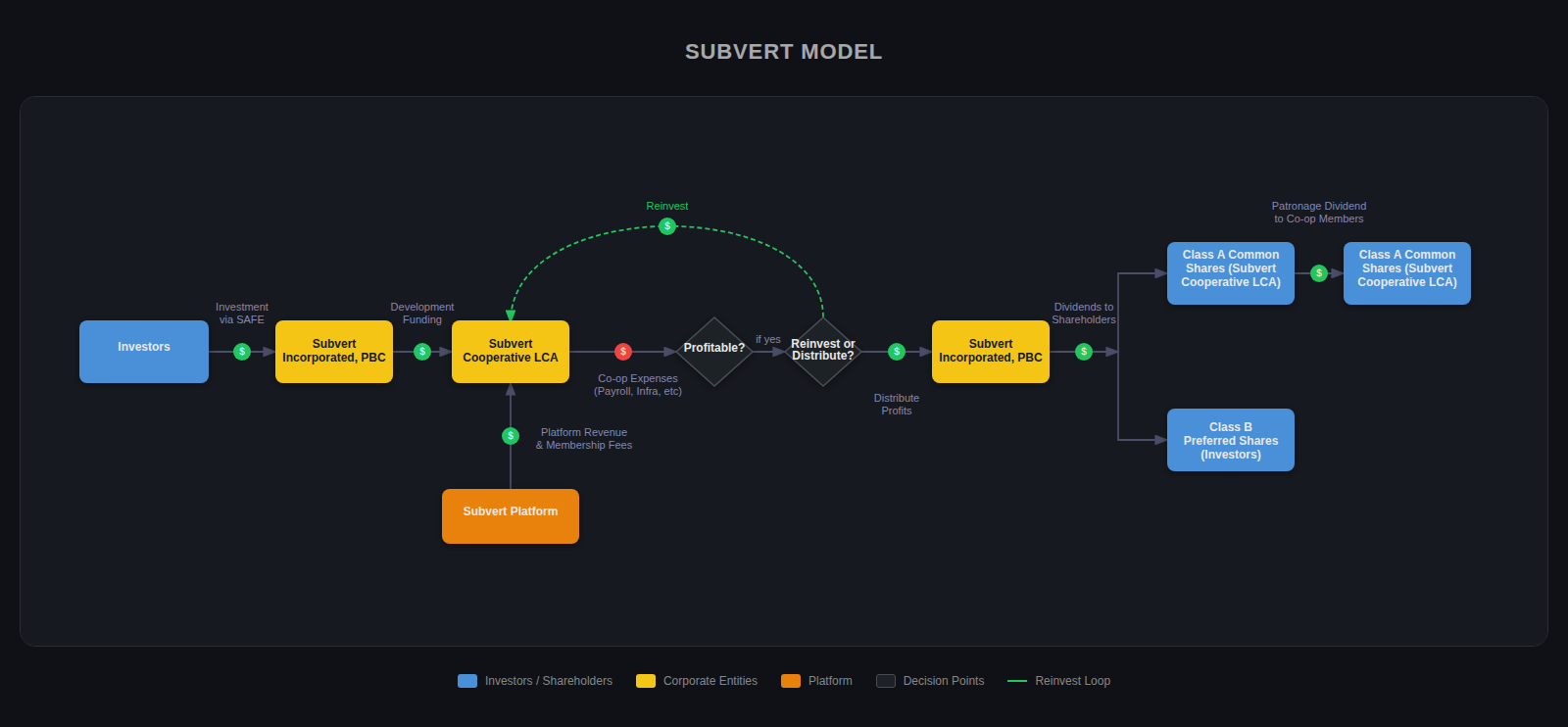
As Subvert puts it: “Even though investors have rights to future shares in the corporation, the cooperative maintains control because: The co-op owns 100% of the corporation’s voting shares, the corporation’s board consists of the same elected representatives from the co-op board, the corporation contracts the co-op to build and operate the platform, and all major decisions go through the co-op’s democratically elected board.
The primary benefit to investors here is dividends as the company grows. An exit event, in most cases, wouldn’t be favorable to the platform’s owners, except in very creative circumstances. Subvert’s manifesto includes possibilities such as selling to a nonprofit that holds the rights on behalf of artists, allowing the corporation to sell or go public even as the cooperative that controls it remains member-owned, or even nationalizing the platform as a public utility, “recognized as critical infrastructure for independent artists.”
“In Silicon Valley, imagination runs wild. Start-ups promise to disrupt everything from how we hail a cab to how we brush our teeth—yet creativity stops when it comes to reimagining the fundamental structure of those businesses themselves,” Subvert’s manifesto says. And, “If we prove that collective ownership can be a winning competitive advantage, we think we will permanently change start-up culture. We will have engineered an evolution of business, opening up the possibilities for how future efforts are founded, funded, and governed.”
With funding and network effects, as traditional companies have, platform cooperatives could emerge from their niche and become real players, ushering in a creator-owned economy—not just an investor-owned one. And if big-name artists can bring their audiences to these platforms, all the better. After all, I can purchase albums on Subvert and Bandcamp, but the catalog on both platforms is limited. If I want to listen to Taylor Swift, I have to use another platform.
In the meantime, I switched to Qobuz, a French platform that not only lets me purchase albums like iTunes does, but also focuses specifically on high-resolution audio—it’s the audiophile’s music app. In many ways, it works a lot like my current iPod setup, but discoverability comes, not by shuffling artists into mindless playlists, but through a curated “magazine” feed that intersperses editorial content with artist interviews and deep dives into the music industry.
That’s how I discovered Fantasyland, an album by the Chinese composer Yu-Peng Chen. He scored the video game Genshin Impact and then decided to score his own fantasy world through a standalone album. “When I started composing Fantasyland, I wanted to build a complete world… with different ‘areas’ representing different cultures,” he said in the interview. “For example, I used Japanese instruments like the koto and shakuhachi for the ‘aquarium’ section… Chinese instruments, like the erhu, guzheng, dizi, pipa, and morin khuur, appear in the part that represents an ancient Chinese city.”
I was instantly hooked, went over to sample his album, and then purchased it. It’s exactly what he was going for: An epic fantasy score, not for any existing film, but for a world of his own making.
Qobuz made a deeper fan out of me—and even elicited a purchase from me—than putting one of his songs in a playlist or putting his album cover in my feed ever could. It brought me right back to the days of collecting the music I love and playing it on repeat with friends. And if I still want the benefits of an unlimited library, Qubuz still offers a monthly subscription for added discoverability—it even comes with discounted album prices and pays artists $0.01873 per stream, much more than Spotify’s $0.004 or Apple’s $0.01. To reach $100,000, an artist on this platform would need only 5.3 million streams, compared to 25 million on Spotify, which is a much more achievable number.
The platform might not be owned by the musicians and audiophiles that use it, but maybe one day it could be, at least in part. When the owner eventually retires, why not sell a portion of it to artists and their fans, and give them a stake in an app that’s in their best interest to succeed?
Why not align the interests of our platforms with those who are actually building them?
I bought a record player 6 months ago. Every month I go down to my record store and buy another.
It is such a pleasant experience.
Tired of Spotify.
I shall look into the other ones you mention.
I learned a few things. Thanks.