


As I was researching Let Cities Build Utopia, I followed a lot of rabbit holes that didn’t make it into the pamphlet. Some of them were dead ends, some were tangents, and some were just failed hypotheses that didn’t make it into the series. On a call with subscribers, Hara Kumar and Austin Tindle mentioned wanting to see some of the deleted scenes. Here are a few that aren’t being repurposed for a future essay.
Saltaire: The company town that inspired Bournville, but was otherwise a tangent to the series
Titus Salt had a front-row seat to the worker strikes and riots that plagued 19th century England as textile mills rendered their labor obsolete. By the time his father retired and Salt became the head of his family’s textile business, their town of Bradford, England had become choked with smog, poor sanitation precipitated waves of epidemics, and workers earned exploitative wages in 14- to 16- hour shifts.
But by the 1840s, Salt had five mills of his own and decided to use his corporate wealth for the good of his workers. At great personal expense, he installed a smoke-consuming furnace to reduce city air pollution, improved ventilation in the workplace, and shortened worker hours. He started advocating for sanitation reform and pollution control at the city level, and eventually became the mayor where he put both reforms into action, despite opposition from his factory-owning peers.
If our benevolent factory owner turned town mayor sounds a lot like Jean Valjean in Les Miserables, well he has good reason to. Injected into this moment comes Charles Dickens critiques of poverty (Oliver Twist, 1838), Karl Marx’s demands for socialist control as a solution (Manifesto, 1848), and in 1845, Benjamin Disraeli’s middle path, a novel called Sybil, in which a benevolent factory owner sees himself as morally responsible for his workers’ welfare. This idea formed the basis of “One-Nation Conservatism,” which Disraeli preached and philanthropist-industrialists made their creed.
Salt, for one was a Christian Congregationalist; he believed wealth was a trust from God and intended to be used for the good of his community. In 1853, he opened a new mill in a neighboring borough that was not only the largest factory in Europe at the time, but also included worker welfare decades ahead of British industrial norms. Surrounding the mill were rows of quality stone homes built for workers, each with its own toilet and plumbed with clean water—a rarity at the time, especially among the working class. Public bathhouses ensured sanitary conditions, and schools provided education for children decades before it became a national standard.
At the mill’s opening, Salt gave a speech to great applause. It was covered in the paper. “Far be it from him to do anything to pollute the air and water of the district,” it reported. “He would do all he could, and he had no doubt he should be successful, to avoid evils so great as those resulting from polluted air and water; and he hoped to draw around him a population that would enjoy the beauties of the neighbourhood, and who would be a well-fed, contented, and happy body of operatives.”
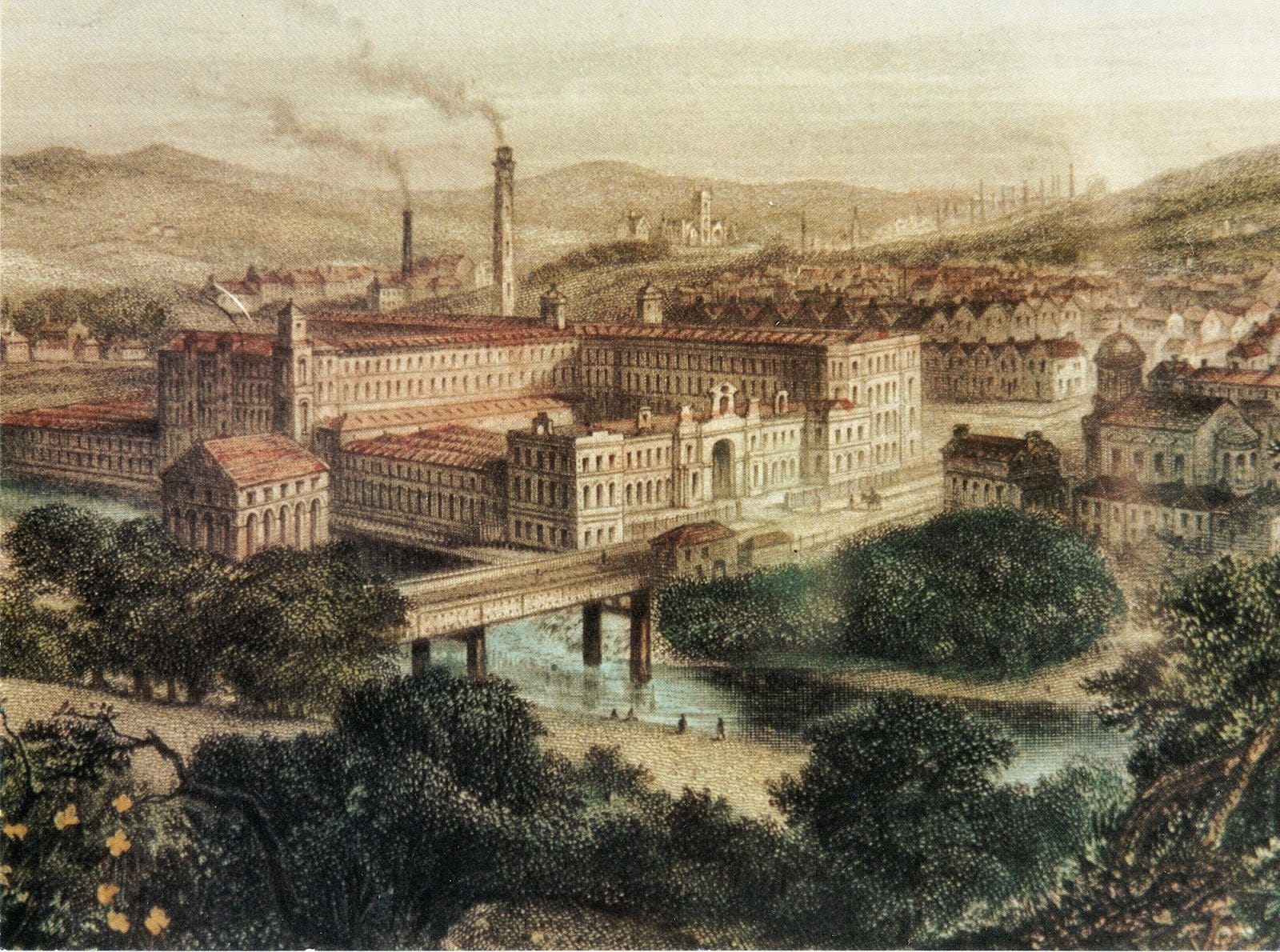
This was just the beginning of what would become an increasingly ambitious project. Salt hired an architectural firm to design, not just the factory and homes, but an entire village designed in the Italianate style, with parks and gardens and curated spaces for leisure along the river. Soon after the mill’s opening, he added fair-priced shops, recreational facilities, and social welfare institutions like hospitals and almshouses for elderly workers. Saltaire quickly became one of the most beautiful towns in the world, and a good quality life for all who lived in it. Workers from surrounding areas vied for a job at the mill and a chance to live in the village with their families. At its height in 1871, more than 4,000 people called it home.
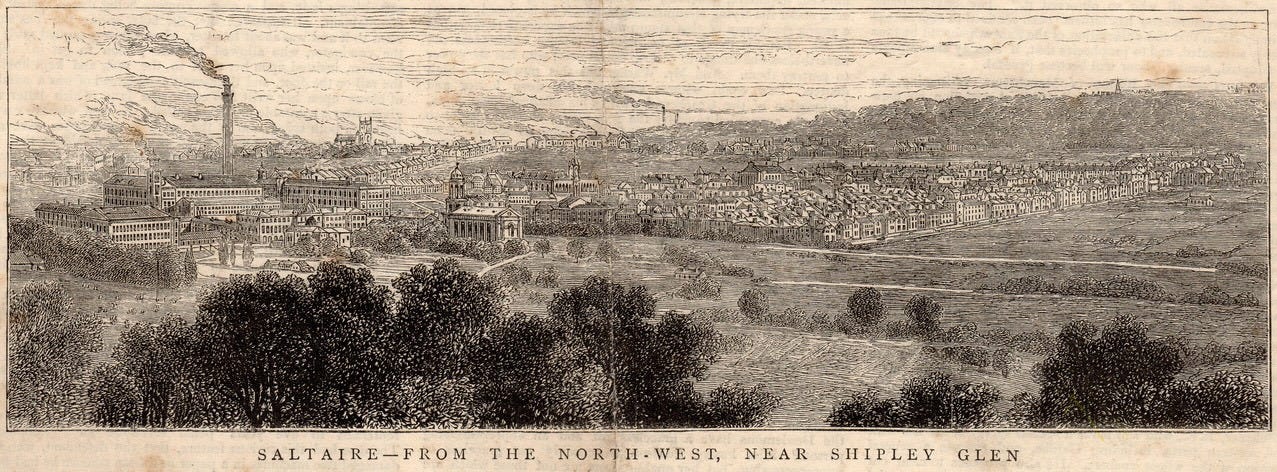
When Salt died in 1876, 100,000 people lined the streets for his funeral, most of them workers for the company. It was one of the largest demonstrations of worker respect for any industrialist in British history.
The village faced ups and downs in the hands of following owners until, like many industrial towns, it declined alongside the industry in the 1930s. But the aesthetically beautiful town would endure as a testament to one of capitalism’s earliest utopian experiments—in 2001 it was named a UNESCO world heritage site and continues to thrive as a residential village with a preserved historic district.
At the 1867 Paris Exposition Universelle, the city was presented as a shining beacon of industrial philanthropy and worker welfare, and newspapers across the continent idealized Salt’s approach. This struck a chord with fellow Congregationalists, but also with the Quakers, particularly the chocolatiers George and Richard Cadbury….
Bournville: Not just a worker paradise, but also a social experiment in virtue
Creating an abundance of leisure activities, George Cadbury believed, would also create a better person.
“In trying to help these men, who were hard at work all day, I very quickly discovered that when night came, the only thing offered them was the saloon,” Cadbury told a reporter. “In some way I must get these men back to the land, and that is why I locate six of my cottages on an acre, planting fruit trees at the bottom of each garden…I am sure that the employee when at work on the land is away from the public house.”
Bournville was a dry city, where the closest thing for workers to do was use the swimming pool, play sports in the village green, or garden their land. This he thought, would create a better citizenry. “For the sake of the state, the citizen should be at his best, and it is the business of the state to maintain conditions conducive to his bodily welfare,” he said. “I strongly desire that the dwellings shall occupy one quarter of the site, the rest to be used for gardens and open spaces… and I want the rent to be so low as to attract the laborers from the slums, but not in any way to place the tenants as recipients of charity.”
Burnham’s Plan of Chicago: A social city that would never work in America
I read Daniel Burnham’s Plan of Chicago in its entirety, and could have written a gigantic section on it alone. Instead, I paraphrased it down to only a couple sentences. What I think was most interesting about the plan is that an early draft of it contained a social welfare mission similar to Ebenezer Howard’s. In his plan, Burnham warned that the city would need to address affordable housing just like London was.
“Throughout the civilized world there is a great forward movement in the direction of transforming cities to adapt them to the improved conditions of living which the people everywhere are demanding, and which, moreover, they feel that they have the power to enforce,” Burnham wrote. “Chicago has not yet reached the point where it will be necessary for the municipality to provide at its own expense, as does the city of London, for the rehousing of persons forced out of congested quarters, but unless the matter shall be taken in hand at once, such a course will be required in common justice to men and women so degraded by long life in the slums that they have lost all power of caring for themselves.”
Burnham recommends the city address affordable housing and that hospitals be provided. “Among us in America hospital service has grown up piecemeal,” Burnham laments in his draft. “The vast amounts of money that hospitals and their equipment cost have been frittered away. There has been no concentration of effort and no well designed general scheme connected either with their erection or operation… Has the time come for the state to take up this matter as a whole and deal with it in a comprehensive manner? The health… of the individual is as important to the state as is the safety of his life, limb or property.”
He thinks the city should build creches for mothers who can’t watch their children during the day because they need to work. He even aims to design more transparent police stations, “so arranged that the policeman can do nothing to any prisoner while hidden from view.”
He removed the bulk of his social agenda from the plan before publishing, perhaps to better appease an American capitalist audience, but there was little hope an American city could provide such services anyway.
The Plan even includes a legal section in which a lawyer laments the lack of action they can take. “Extensive municipal and governmental works are more quickly and easily executed in those parts of the world where the legislative authorities have a free hand than they can be under a system of rigid constitutional restraints.”
Pullman: A masterpiece in city planning, but a complete failure at social welfare
I first wrote about Pullman as a utopia before I read the book about it and realized it wasn’t. Like Saltaire before it, the railroad town was built for workers just outside of Chicago, and for several years it was absolutely a worker paradise. The owner and founder George Pullman even built a special traincar to transport guests from the Chicago Exposition to the town, and people marveled at how beautiful it was.
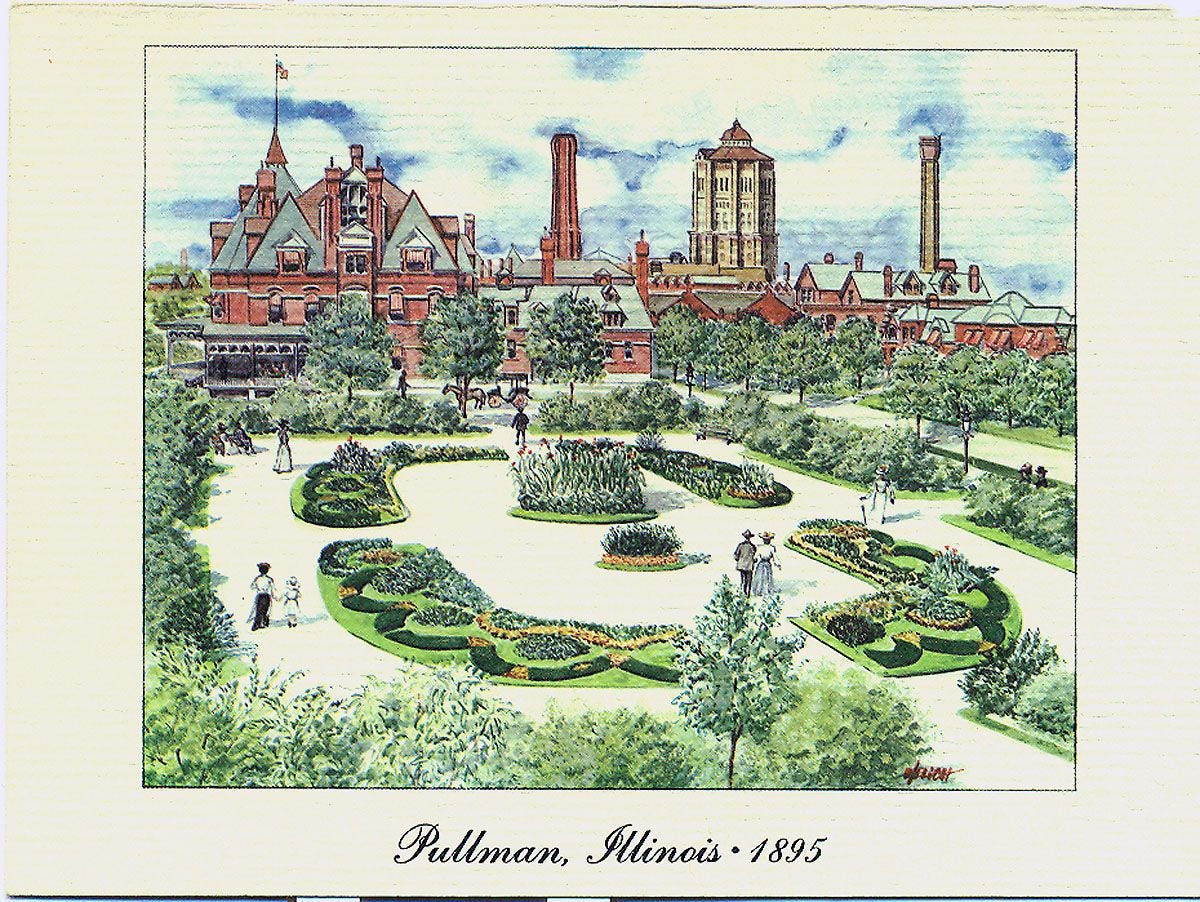
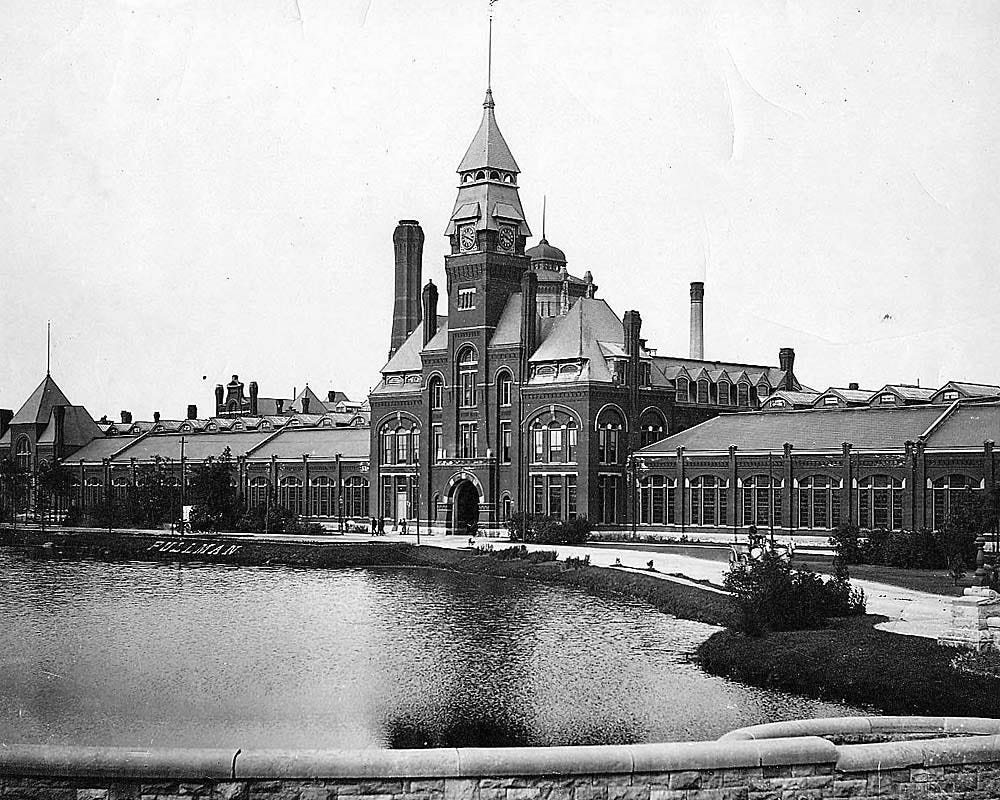
I reduced it down to a paragraph in the final essay, a cautionary tale of what happened when the wealthy industrialist cut everyone’s pay, but didn’t cut their rents. Employees were screwed twice, by an employer who was also their landlord, and were fired for attempts to unionize!
Disney Robots are cooler than Chinese robots but have nothing to do with cities
When the World’s Fair came to New York City in 1964, Disney Imagineers built a whole warehouse for their next advancement: Humanoid Robots. My dad attended the fair as a seven-year-old and still remembers watching a robotic Abraham Lincoln deliver the Gettysburg address to an awe-struck audience!
Today, Disney humanoids—built for entertainment rather than manufacturing—are some of the most advanced robots ever built. While China’s 2025 Robot Games showcased remote-controlled robots stumbling over steps, Disney’s “stuntronics” can perform aerial acrobatics—flipping through the air for Marvel-like superhero stunts. If you haven’t seen them in action yet, I beg you to watch the videos. 👇🏻
Pandora’s Na’vi Shaman robot, built for the Avatar-themed “Na’vi River Journey” attraction is one of the most lifelike humanoids created, able to move its face and body in the fluid way of a human, rather than the rigid mechanical movements of an automaton. Videos of the robot without its skin are equally impressive, showing the ways its hundreds of muscles form lifelike expressions.
I found these an impressive and fun tangent on Disney, but they ultimately had nothing to do with city building.
Thee aren’t the only anecdotes from the cutting-room floor, I deleted a large section that I am now developing for a future essay. In the meantime, let me know if you enjoy reading the deleted scenes….
Thanks for reading!
Elle Griffin
Thank you for doing these deleted scenes. Hearing Burnham talk about healthcare and affordable housing really makes me sigh… the conversation hasn’t changed. It really reinforces that good social policy is good urban policy.
I think with the combination of Chinese robotics, voice AI, smarter LLMs, and Disney robots, we could have a real Westwood situation on our hands.
Disney sort of already has everything they need to do something along those lines. I wonder if they are working on something like it already.