


This is a guest essay by lou millar-machugh (they/he) for Internet Sovereignty, nine writers exploring the future of the internet. Collect the complete pamphlet as a digital or print edition. 👇🏻

The kind of design that goes unnoticed—a short-term rental agreement, a cleverly put-together government announcement—is the kind that often creates the authority that rules our lives.
In the past, this power was wielded by colonial empires to obscure their violent extraction, thereby creating legitimacy and a veneer of ‘civility.’ Today, these same mechanisms are wielded by Big Tech to erase the people who really built the internet, in an attempt to justify the concentration of power and wealth in the hands of the few. Our job is to reveal these mechanisms.
Colonial regimes used cadastral surveys, pass books, and civilising‑mission rhetoric to turn land theft and extraction into orderly, documented governance; today, Big Tech disguises extractive data practices in metric dashboards and “innovation” language that looks similarly procedural and neutral.
The imbalance between the real creators of the internet and those who control it is built into the internet’s design. Making this power visible—the power of creators, content moderators, media organisations, journalists—opens space for us to govern the internet on our own terms.
The internet is not magical
Most people’s everyday experience of the internet is that of a mystic force attributed mainly to the work of a select few tech oligarchs.
The experience of the internet as a mystic force is a design choice, subtly ingrained in the collective subconscious through the concept of “Seamless Design.” This philosophy is the guiding force behind most modern interface design, and it teaches that the “seams” of our digital experiences ought to be invisible, nominally to create a more “intuitive” user experience.
But by making the seams of the digital expertise invisible, you also make the people behind it invisible. Seamless Design may make it easier to post a quick snap of your family dinner—but it does not make it easier to exist in and create a more equal society.
TikTok’s estimated 2022 revenue was $9.4B, yet the average creator earns less than minimum wage per hour invested. The “creator fund” is notoriously opaque, and it’s very unclear how creators are actually compensated. The messy editing process, the hours that go into each video, not to mention the content moderators, the infrastructure workers, and the software engineers, are all invisible. The like, comment, and share buttons are designed to give us a rush of social validation without giving us time to pause and notice — or question — anything else, or anyone else but ourselves and the person we see on our screens.
Against the magic wand icon
Many AI tools are marked with a magic wand icon, magic sparkles, or other visual cues that indicate they are mysterious, magical, and not to be questioned.
Rationally, we all know these AI outputs aren’t the result of a magical wizard hiding in our laptops, and the insistence from tech companies that this is the case makes people feel lied to. We are all being expected to unilaterally accept that these tools make things appear out of thin air, whilst knowing that common sense dictates otherwise. Thus begins the social outcry, frustration with AI across all platforms, and a growing refusal to use AI in any capacity.
The human sense of navigation is core to how we interact with the world. We find ways from A to B by gathering information and plotting a course of action. Whether we are finding our way to a friend’s house or to the information we need on the internet, we are using the same skill set, and this skill set is essential to our sense of agency and autonomy over our experiences.
In its current form, AI, through the ideology of seamless design, erodes this agency. People have a clear emotional need to find their own way on the internet, and the failure of the magic wand icon underscores this. People need to navigate their own way, build mental models, and understand the path. Simply presenting people with answers isn’t how we’re wired.
Externalising collective imaginations
Social media platforms externalise the imaginative work that goes into creating our shared futures through a form of cognitive offloading, which Bernard Stiegler, ex-bank robber turned philosopher, coined tertiary memory. Tertiary memory is a form of memory that encodes others’ experiences into our understanding of the world, and it is key to social processes, playing a central role in the learning abilities that set humanity apart.
Stiegler argues that technics (technology in the broad sense of the word, extending to tools such as writing, art and machines) create these tertiary memories through our interaction with them. These technics have the power to create social reality through these processes, by dictating what is and is not part of our tertiary memories.
With social media as the primary medium in the social sphere, we find a significant portion of the population with an individualistic tertiary memory and, as Steigler argues, a diminishing sense of a collective, shared future. This causes a sense of constant now.
It’s in the best interest of Big Tech to continue this emotional sense of constant anxiety, constant now—this sense of anxiety that keeps you hooked on their platforms. Through technics and the creation of tertiary memories, we do not develop a collective understanding of one another, of our future, or of the real work behind the internet.
A future in which this invisible labour is considered, and wealth and power are more evenly distributed, must adopt a different view of labour representation for the end user. If done correctly, this will enable the development of a collective consensus for a co-operative, sovereign internet by creating a new set of tertiary memories that build on and understand the labour of the digital age.
Seamful design as a democratic right
A design philosophy grounded in sovereignty, co-operative economics, and democracy should reform relationships among users, workers, and organisations by making the underlying work and the institutions that shape it legible. Seamful design is an approach that advocates showing the ‘seams’ of the internet to users, as a key to promoting democracy in the digital world. Its advocates question the premise of “seamless” design, arguing that the harm done to autonomy and power relations far outweighs the perceived positivity of a “seamless” experience.
What might this look like in practice? Design interventions that follow these principles should allow people to easily understand the connections between the pixels on their screen and the people behind them. It should be non-intrusive, working towards an internet that promotes community cohesion through gentle awareness.
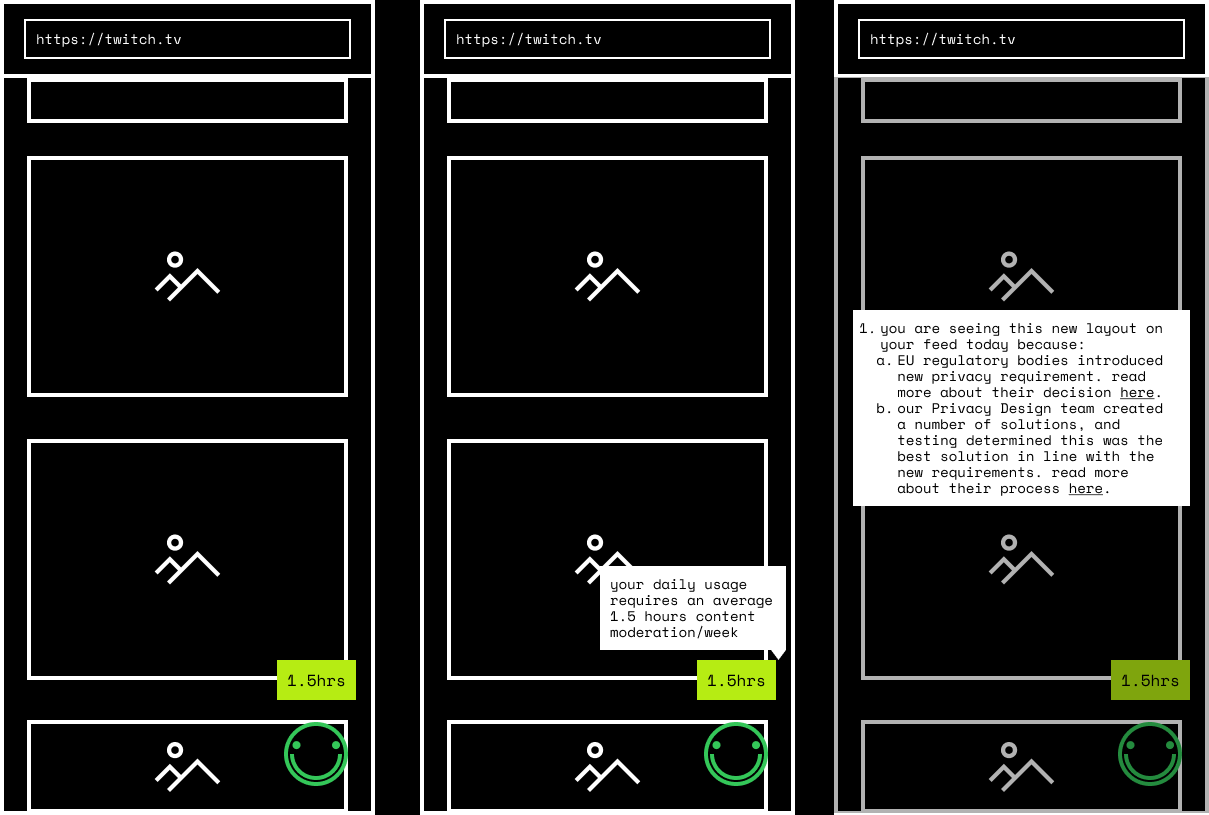
Solution 1: A dedicated, easily accessible interface element (e.g., a small, persistent icon) that, when clicked, reveals the specific policy version, the governing body (e.g., a DAO, a corporate board, a community council), and the last three policy changes that directly affect the user’s current view or interaction.
Solution 2: A persistent, non-intrusive interface element that displays the real-time, cumulative labour cost (in time, money, or compute) associated with the content being consumed. For a short-form video, it might show: “Content Creation: 4.5 hrs (Creator X); Moderation: 0.02 hrs (Mod Y); Compute/Bandwidth: £0.003.”
Legibility as ideology: Case studies in governance and labour revelation
We can see this in practice through two seemingly opposed examples: the widely used Wikipedia and the controversial Palantir. Both entities are experts in creating tertiary memories through a fascinating combination of obfuscation and a deep awareness of the labour processes behind each click, and how these processes should be organised and communicated to end users.
Wikipedia & the emotional foundation of institutional transparency
The co-founder of Wikipedia, Jimmy Wales, has been appearing in the media to discuss the controversial Online Safety Bill and its implications for Wikipedia’s mission, particularly the role of moderators and the risks of being required to disclose their identities.
Wikipedia has long advocated community-built technology rooted in values of transparency and transparent governance. This approach has allowed it to build arguably the most successful knowledge-sharing infrastructure on the internet. What sets Wikipedia apart is the transparency of its labour and governance procedures.
The visibility of edit histories allows users to track changes, understand the collaborative effort that goes into each page, and recognise the contributions of diverse editors. This not only creates transparency but also lays an emotional foundation of trust, shared ownership, and togetherness. The friction throughout the creation process of each and every article is clear for all to see through these edit histories, restoring a sense of trust in the truth of the information in each page - in an age where this accuracy is often underconsidered.
The system is designed to be self-sustaining and demonstrates how clear, transparent systems and people-design can align a large, messy base with a public‑good mission by building emotional investment and collective consensus.
Palantir, technopolitics & unconscious drives
On the other end of the political spectrum, we can also see the infamous “definitely not a data company,” Palantir, as another example of the crucial importance of careful, deep consideration of labour and decision-making processes.
Often portrayed in the media as a Disney-villain-like entity, Palantir takes on data interpretation work for public bodies, which are themselves often portrayed as militaristic or otherwise nefarious. They have developed their terrible reputation through questions about surveillance and algorithmic bias that inevitably arise in any work involving large amounts of sensitive data.
For example, Palantir’s predictive policing software, deployed in US departments like the LAPD, has been shown to perpetuate racial biases by disproportionately targeting minority neighbourhoods based on historical arrest data, amplifying existing inequalities through opaque algorithms. But this happens across almost all examples of AI & data being used in the public sector. Virginia Eubanks’ “Automating Inequality” discusses this in relation to welfare systems, where automated decision-making often leads to vital support being unfairly denied to vulnerable populations. “I, Daniel Blake” is a dramatisation of a real story in which similar algorithmic decision-making led to dire consequences for many UK benefit claimants.
The theatrical reputation they have developed serves to obscure the largely mundane data and integration work the company actually does, allowing them to get ahead of any criticism by painting themselves as the villains from the get-go and using that reputation to oversell the work they provide.
Their CEO, Alex Karp, has a background in philosophy and psychoanalysis, with a particular interest in Marxism and humanity’s tendency to relieve unconscious drives through irrationality. Karp calls himself a socialist and is known to lecture his employees on the importance of Marxist theory (while maintaining his wealth and position, of course).
Palantir’s edge does not lie in uniquely advanced software, but in understanding and shaping institutions and unconscious drives. Karp’s most recent book, “The Technological Republic,” while of questionable scholarly integrity, also sheds light on this. The book examines and explains the different organisational structures that inspire Palantir, including honeybee swarms and flocks of starlings. Taken together with Wikipedia, this shows how labour and decision‑making are considered, framed and revealed to the public are central to pursuing any ideological project for the internet.
Community cohesion through design
Ethics are important, but we won’t win people over on ethics alone. The contrast between Wikipedia’s transparency and Palantir’s theatrical approach highlights the potential for design interventions that move toward a genuinely co-operative and sovereign internet, in which conscious technopolitics distributes power fairly among users, communities, creators, journalists, artists, and infrastructure workers.
A new design paradigm is about building a more democratic, open internet rooted in principles of sovereignty through legibility and clever design. But it is also about a psychological transformation from isolated interaction toward a more integrated community experience.
It is about improving people’s day-to-day lives and experiences by giving them the information they need to see themselves as part of a whole society, make informed choices, connect with others, and feel good about their decisions.
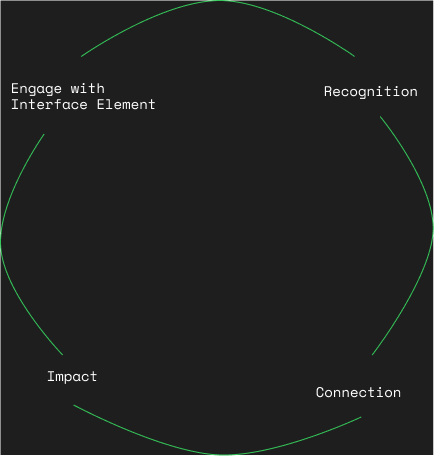
A redesigned reward loop would de-emphasise individual vanity metrics (likes, shares) and instead highlight metrics related to collective effort and shared achievements. This loop could involve 4 key steps:
Engage with the interface element (such as the cumulative labour hours widget)
Recognise others involved in the process, fostering a sense of community by seeing yourself in the Other (which is essential in identity formation).
Connection & Impact: With a new understanding, connect with others and make an impact beyond the screen. For example, donating to Wikipedia.
This creates a small emotional reward, starting a gradual shift towards an online culture that values the hidden labour behind the internet. Ensuring this reward creates the change it intends to involves carefully considering the appeal and design of the element (is it clear and visually appealing), and asking the following questions:
Considering recognition processes and how this element builds solidarity, will the user recognise themselves as part of a social whole through this design?
Is it accessible for the user to create real change after the experience (for example, in their consumption patterns, or by connecting with others)?
What’s next?
This is why I’m part of the team building BTN Media—a news aggregator with a distinct focus on UK independent media. Currently under development, Bulletin is a news aggregator redesigning the relationships among independent media, online revenue streams, and readers.
Building BTN means mapping out every decision point and process—aggregation, publisher outreach, algorithmic curation, moderation, community feedback, and engagement. Each of these elements is being designed to be transparent and democratically shaped, ensuring that labour and automation are both visible and continuously improvable.
To achieve this, we’re prototyping a microtipping incentive structure. This system empowers readers to direct money and data to specific outlets and projects, making it clear where their support goes. By providing clear breakdowns of “where your money goes,” we hope to align autonomy, emotional investment, and trust for everyone involved. This is the blueprint for a new digital contract that places readers, publishers, and technologists on equal footing as collaborators in the future of news.
What do we need to do to see this implemented at scale? That is not a question I can answer here, but I hope to have made a start. The next steps should involve developing a voluntary design framework, tracking its effectiveness, and using this research to lobby governments and engage larger organisations. The key to a sovereign internet is deliberately designed connectivity, and proof that this design method works, creating emotional connection beyond individualistic engagement metrics. Let’s get started.

Oh if only I could post an image comment!