


“If everything is automated, how should I spend my leisure time?”
I’m asking an AI, but not Claude or ChatGPT. This one is trained on the works of William Morris, a textile designer during industrialized London, and a socialist who raged against the machine.
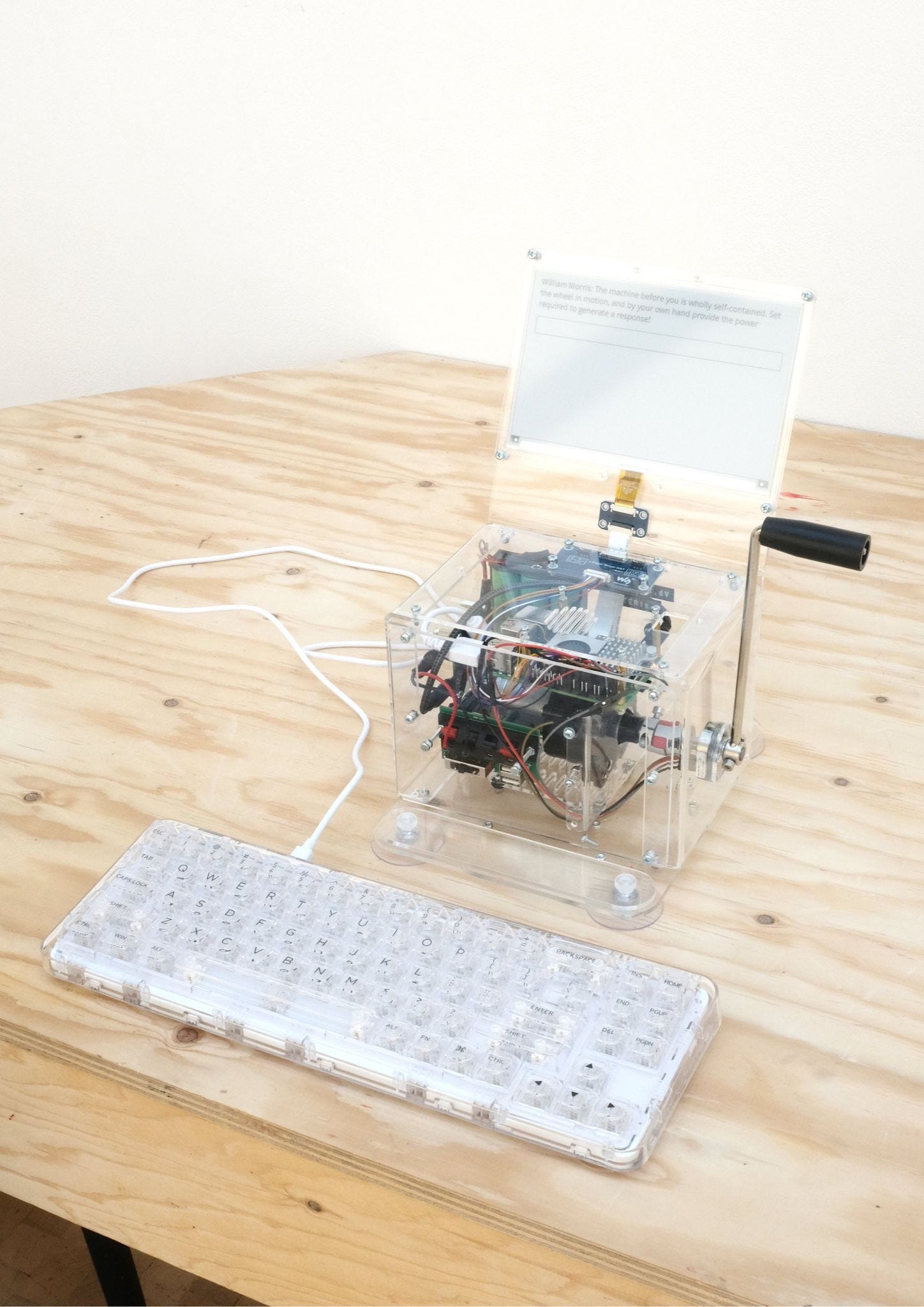
And this AI does not live in the cloud, hosted on large data centers; it’s in my home—a small clear box disconnected from the internet or even power. It doesn’t use water or energy from the grid; I turn a hand crank 50 times to power it up and get his response.
Yes, that’s right. It’s an anti-AI AI.

“Ah dear friend, you’ve traded the sweat and toil of a human existence for the luxury of automation,” Morris answers me. “But what of the richness that comes from toil?”
A beautiful life, he says, comes from effort and dedication—from working with our hands: knitting or woodworking or building. If we automate all of that, what do we have left to do with our day? Watch TV? Spend hours on social media?
Is that the future we want to create?
The artist and industrial designer Max Park doesn’t think so. His father grew up near Morris’ house in London, where his grandfather repaired watches and his grandmother worked as a seamstress. Like me, Park became enamored with Morris’s 1890 utopian novel News from Nowhere, which imagined a future of artisans, everyone free from the drudgery of factory work.
Handcrafting was the good part of life, he thought. Why would we want machines to do it for us?
With AI, machines do so much more for us than they did in Morris’ time. They automate, not just our labor, but our thinking too. Park saw his grandparents’ crafting dwindle, and Morris’ artisanal and intellectual future slipping even further away. “We seem to be creating an environment with completely different ideals to Morris’ world,” he said in a video. “And I was thinking, if he were still alive, how might Morris suggest we get out of this mess?”
Park thought AI was part of the problem, but also wondered if it could be the solution. Could better design create a world with more artisans, rather than automating them away? This was the question he ventured through a design project titled “Prompting Nowhere,” a nod to Morris’ novel. The result was the hand-cranked AI that now lives on my desk, but also the centerpiece of his project: An AI powered by the very symbol of industrialization, the treadle sewing machine.
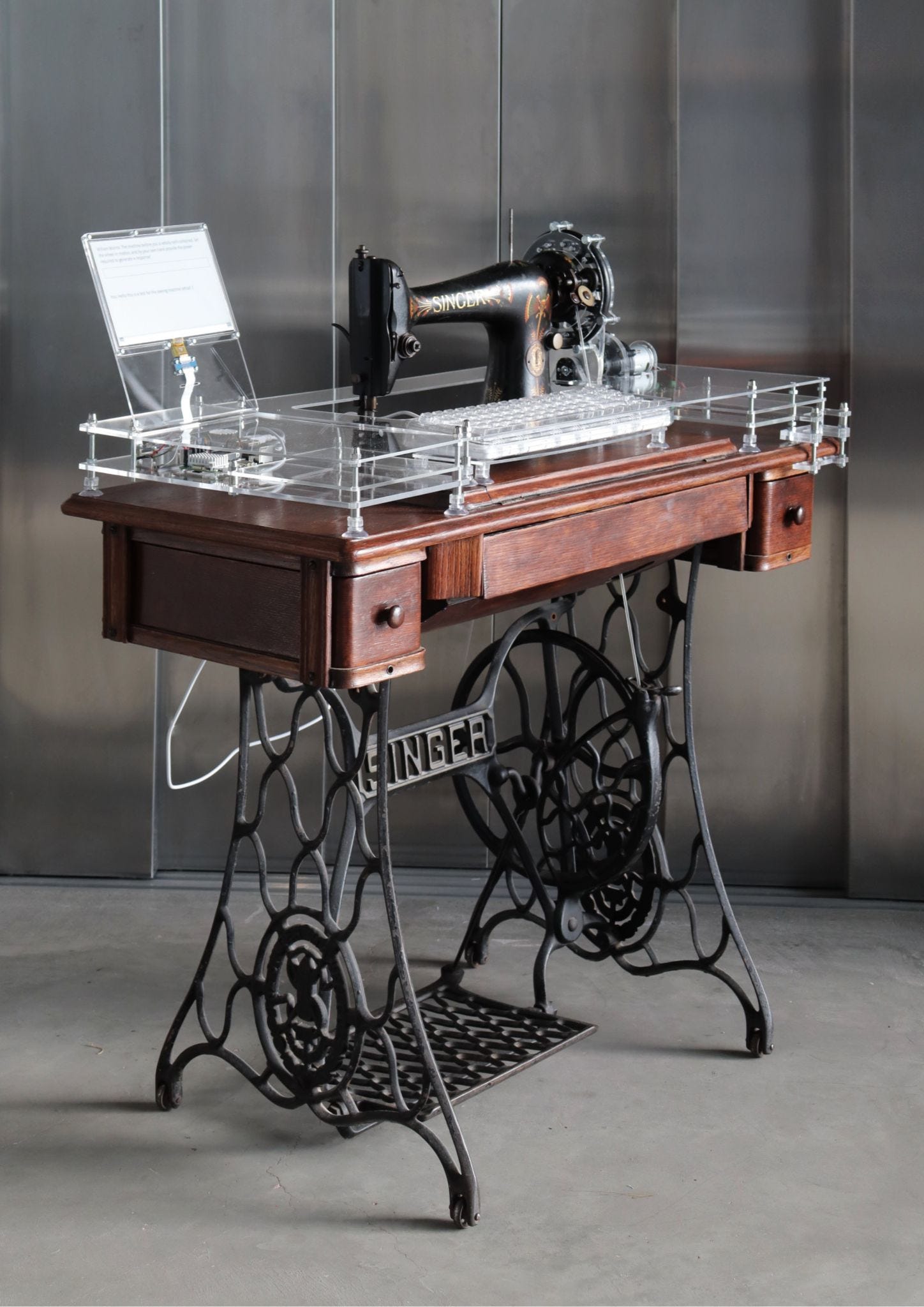
In the mid 1800s, this foot-pedaled sewing machine was often the most expensive and treasured possession a family owned. At home, it symbolized freedom: a hand-sewn shirt might take 14 hours, but with the machine it might take one, and create a path to independent income for many women. But at the factory, the treadle sewing machine also powered the sweatshops, extracting more and more output for menial pay. When paired with capitalism, these “labor-saving devices” didn’t shorten the workday; they raised how much women had to produce in a day for their dollar.
This juxtaposition—technology both freeing us from drudgery as well as enslaving us to it—served as the crux of Park’s project. As part of his research, he interviewed Brian David Johnson, an applied futurist who reflected on the first Industrial Revolution, and specifically the English textile workers who once smashed the mechanical looms of adversarial factories. “Looms weren’t the problem,” he said. “It was actually the industrialists and the capitalists.”
He’s right. In the early 19th century, the “Luddites” weren’t against technology; they were against how that technology was being used: to drive down wages, to put work in the hands of cheap unskilled labor that hadn’t served apprenticeships, to evade trade customs and regulations, and to make a few rich churning out shoddy goods while degrading the tradesmen who once made superior ones.
To this day, we use the term “Luddite” to mean anti-tech, when our actual grievance, then as now, is with the social arrangement we created with that technology.
Johnson says the question we need to ask isn’t whether a given technology is good or bad, but what we are optimizing it for.
In the modern AI world, we might say autonomous weapons or the ability to beat China if it comes to war over Taiwan. Perhaps we’d say the economic superiority we gain because “the world is going to be built on someone’s AI stack” so it may as well make America’s companies rich, not China’s. America wants the biggest military and the richest economy, and that is what our AI is being optimized for.
What kind of world does that create? One ever escalating toward war. Where AI is rushed, developed at breakneck speed to win a geopolitical or economic race, with few guardrails to ensure societal wellbeing. It means AI that is owned by and benefiting companies and investors rather than the people who provided all that data and the workers who might be automated away because of it.
What did Morris want to optimize for? Beauty, and a life spent in pursuit of beauty.
What would AI be like if it were optimized for a beautiful life? Maybe it becomes like Socrates, asking questions instead of giving answers, encouraging us to be thinkers rather than passive consumers. Maybe it automates away our desk jobs, so we can spend less time on the computer and more time raising children. Maybe it funds increased leisure time, so we can spend more of our lives working with our hands, rather than sitting on screens. Maybe AI could create a more offline life rather than a more online one.
Park wanted to explore this better end as an art project. Not only did he train his AI model on Morris’ work, but he wanted to power it with the work of our hands. When Park invited the designer John Corcoran to experiment with his first hand-cranked version, a clear box similar to mine, Corcoran began singing an Italian opera because, as he cranked the machine, he said he felt as though he were making pasta.
Making pasta with our hands, singing an Italian opera that filters through our kitchen windows, these are the things that make life worthwhile, but having the leisure time to do so is still a privilege. Morris was only able to avoid factory work and spend his day engaged in textile design and furniture building because he was affluent enough to do so. Today, it’s computer work we must be privileged enough to escape.
When a friend and I recently reviewed our screentimes, she was shocked to discover how many hours she spent on TikTok, something she doesn’t actually want to be doing, while the things she wants to be doing—quilting, an unfinished sewing project—remained stowed away in her cupboard. But that’s because, when we spend the day bent over our laptops, the last thing we want to do is more work, so we reach for something passive instead. Something that requires no thought at all.
It is no wonder, then, that in the US, the “trad wife” has become a symbol of privilege. The idealized woman has time to bake, tend chickens, and run her farm, while her children live a sort of bucolic fantasy. Many might prefer to spend their days engaged in similar pursuits, as evidenced by the rush on homemaking activities during the pandemic, but doing so requires enough financial security that we can spend our days away from our computers.
Technology is not being optimized for that result.
AI may have given us super powers, just as the treadle sewing machine once did, but now as then, we work the same amount of hours despite doing so much more with them.
Park admits that comes with benefits. He’d intended to train the LLM model himself, but after an entire day spent “instruction tuning”—writing prompts and answers by hand—he’d only completed 250 pairs of a necessary 5,000. It became clear he was better off using ChatGPT, which completed the rest within seconds. He also needed additional power to get started—it would have taken 1,500 years of continuous cranking to train his small model by hand. Instead, he used Meta’s Llama 3.2 1B model as the foundation for his AI, which consumed 259,000 kWh of power in its training.
If we were living in Morris’ ideal world, this automation of tasks would grant us a 20-hour work week. But Google and Meta aren’t optimizing for a well-lived life, they are optimizing for profitability and value. If AI allows me to complete twice as much work in a day, companies won’t cut two workers down to part-time and let us keep our full-time wages. They will fire one full-time person and pay less in overall salaries. This is the future data foundries like Surge and Mercor make explicit—both companies pay knowledge workers to train AIs on all the things that still require a human, so that Google and Meta can one day go without them.
That’s why governments need to step in to mandate a shorter workweek. Make 30 hours a week the new normal, just as we once made 40 the standard during the factory era. If people can get the same amount of stuff done while using AI, why shouldn’t they? And when AIs require humans less and less, we can reach the George Jetson ideal, working just 9 hours each week to push the buttons and pull the levers AIs still can’t or shouldn’t.
What would happen if leisure wasn’t a privilege, but the norm? We have hundreds of years of proof: We spend more time raising our children, tending to aging parents, and checking on neighbors—the kind of care nations struggle to provide are things we could provide ourselves if it weren’t for our workloads. We strengthen civic life and democracy because now we have the opportunity to get involved in local associations and volunteer organizations—the erosion of which has precipitated our failing democracies. We contribute more cultural goods to our societies, like music and writing and entrepreneurial pursuits that might not be profitable, but bring value to communities nonetheless. We host block parties, bake cakes for a friend’s birthday, raise chickens and share the eggs with neighbors—things that foster social cohesion and can’t be produced by paid employees but only by passionate individuals with time. We spend less time online, because we no longer need to passively unwind after a long day. Even our health improves, because we have more time to move our bodies, which puts less strain on our healthcare systems.
All of us benefit from increased leisure time—the AIs most of all. Because we spent billions of hours creating the entire internet and everything the AIs were trained on, unpaid. We did it with our free time and our social media posts and our blog posts and our academic research papers and our books.
As part of his project, Park asked Róisín Inglesby, curator of the William Morris Gallery, whether she would contribute her work to an AI even if it weren’t traceable back to her—so long as she were free from financial concerns. Inglesby said yes. I would too. If someone learns something because of the hundreds of hours I put into researching it—great! That’s why I do the research! But in practice, the platform benefits much more for surfacing those results than we do researching it. The key part of Park’s question is “so long as we are free from financial concerns.”
Some think we should compensate that unpaid labor through data unions or AI-funded sovereign wealth funds—both provide a partial solution. I’d go even further: I think every company should be owned by stakeholders—not just the investors of a company, but also the workers who built it, the customers who buy from it, the data unions that represent our data, the governments that fund R&D, and the municipalities that host the company headquarters or data centers. If people and places hold equity in the companies we participate in, then it wouldn’t matter if labor was automated away. We’d hold equity in the economy we create and earn dividends from that collectively held value.
In this world, governments could tax companies instead of incomes and fund important services that ensure our wellbeing—like healthcare, reskilling sabbaticals to retrain the workforce as needed, and guaranteed jobs at a guaranteed living wage. In a world where work is automated away, this combination of supports would mean people always have access to healthcare and the guarantee of work and a good paycheck. This last one means governments put people to work doing the things we still need humans to do, just as Franklin Roosevelt’s New Deal once employed 8.5 million people to build roads, bridges, schools, and parks during the Great Depression.
William Morris thought we should eliminate “useless toil” even as we remain financially secure enough, and with enough leisure time, to engage in “useful work”—working with our hands and bodies and minds. Morris never explained how we’d arrive at his world of artists and artisans, but maybe AI finally does. With provisions to ensure we remain well cared for and policy to protect our time, why couldn’t we automate away the rote parts of our lives even as we spend most of it off the internet?
But it’s not just our time and labor and incomes Park wants to protect, but also our data. In England, the National Health Service entered into a contract with the surveillance platform Palantir to much public outcry. “It’s terrifying that if I use the NHS, my medical data is going to be accessible by this company,” Park told me. “And we’re not limited to that. It’s a given that if you go out in the world and you go to the supermarket or cross the border, you are in the system.”
We are well aware of this bargain. Every Facebook, Tesla, Strava, and Roomba user trades away their privacy for access. So does every Claude and ChatGPT user. We grant permission to every smart car and smart toilet and period tracking app to harvest our data. We are traced through every Uber trip and Amazon purchase. We are listened to by every smart speaker in our home and every app on our phone. Target famously knew a customer was pregnant before she told anyone else.
No one thinks this is a good idea. We are being surveilled every hour of every day, even in our own homes, and our data is known by a vast network of companies and governments we don’t trust, but there’s little we can do about it. We click “agree to terms” without reading the small print. We have to in order to use anything.
Park solves this problem with locality and private ownership. If the data is never shared with the cloud to begin with, then no one else can access it by default. The AI he built for me lives solely on the microchip embedded in the clear box on my desk. I could smash it with a hammer and it’s gone—every question I asked and every answer I received permanently unavailable to the companies that made it. “It doesn’t go off to a data center. It’s not backed up on the cloud,” Park says. “It’s all happening exactly there.”
What I wouldn’t give to be able to use my Claude the same way—to download it to my computer and have it live there, never reporting back to corporate. Vitalik Buterin, the founder of Ethereum, went to elaborate lengths to make his AI work that way. It was nearly impossible for him to create, even as a highly specialized and technically apt individual, but his argument is that it shouldn’t be. Privacy and data sovereignty are technically possible, the only reason companies don’t build their products that way is because they profit too much by doing it.
Governments could stop this. They could mandate that companies only collect what’s necessary to provide their service. They could ban surveillance advertising outright. Even states make a difference: Illinois’ biometric privacy law, passed in 2008, mandates that before collecting someone’s biometric identifiers, like fingerprints or face scans, a company must get written consent from the user, publish a retention and destruction policy that means the data is destroyed after use, and agree to never sell the data. Any individual can sue for damages per violation.
And they have.
In 2010, Facebook was able to start making “tagging suggestions” because the company built a vast database of faceprints from uploaded photos without asking. Illinois residents sued, Facebook fought for five years but lost. The company paid out a $650 million settlement, and 1.6 million Illinois residents received checks of $340 to $400 each. The triumph: Facebook shut down facial-recognition entirely, worldwide, and deleted more than a billion faceprints.
One state law enforced by ordinary citizens helped force a trillion-dollar company to abandon facial surveillance.
Illinois gets much better tech as a result: Google’s Nest cameras and Amazon’s photo recognition tools give Illinois the tracking-free version. Even Sony’s Aibo robot dog ships to Illinois without facial-recognition software. Apple’s Face ID and photo recognition survives solely because it passes the test: Facial recognition happens only on your own device under your own control, and Apple never receives the faceprint.
All of this serves as its own kind of proof: surveillance is optional. More states and governments should mandate that companies remove it.
It will be an uphill battle: governments benefit too much from the data to do anything about it. Governments buy the data they need from brokers, or subpoena it from companies that originally collected it for advertising. It’s how ICE gets around needing warrants to get information—they can get the information directly from tech companies like Palantir instead. The proposed “Fourth Amendment is Not for Sale Act” is designed to target this loophole. We should pass that too.
But if the AIs won’t create for anything but economic gain, the artists will. It is through his locally hosted, handcranked AI, trained on the work of an 19th-century social reformer, that Max Park makes a poignant statement during this moment: What we want isn’t more technology, more screens, more automation, more surveillance by companies and governments, all so that we lose our jobs or fight in more wars—even if those are the ends nearly every AI is after by default.
What we want is more leisure, the opportunity to work with our hands and raise our children. To live free from surveillance and privacy concerns. It is possible to build for these better incentives, to design for beauty, and it is this future, more so than any other, that we are fighting for when we rebel against data centers that pop up in our backyards, that use our water and power and resources and siphon wealth to investors and companies and governments that will use them for their own gain at the expense of ours.
As with the Luddites who came before us, the problem was never that we created a superpower, it’s that we’re using it for supervillain gains when it could be used for our own.
It is this polarity that I explore, not just in this essay, but in the coming essay series. Because AI and technology have created a world of advancements, but for who? And to what end? How are we tangibly making life better for all of us? Because most often, I would argue we’re not.
It is for this reason that I became entranced by Max Park’s project to reimagine technology from the view of one of my favorite utopian thinkers. And, when I reached out in emphatic support of his work, he offered to build me a final version of his AI on commission. The sculpture that now sits on my desk—private, local, personal, owned—will forever remain an affirmation of beauty and a reminder of what technology can be when it is optimized for a life well lived. Not just profits.
I hope Morris’ dream will finally be realized, and that we will choose to optimize for that future.
Thanks for reading,
Elle Griffin
The idea of a 30 hour work week is a great stepping stone.
Let’s also remember that in News from Nowhere, Morris was writing about a world that did not have money, or jails, or organized schooling. Kids were free to do and learn what they wanted. I think I remember two kids staffing a handcrafted pipe shop where you could just walk in and obtain a pipe that you liked? Meanwhile the adults were heading up the canal to help harvest grain.
It seems his premise was that, if people weren’t out there hoarding money and flooding the world with cheap junk goods, meanwhile simultaneously stealing the majority of the value that workers create, then everyone would be living the high life.
Doing the math, I think he was quite accurate about that.
I mean, there are social/structure problems to tackle, but from a resource and human effort perspective, there is no reason why every person in the the world can not be fed, housed, and have a large amount of leisure time. We already figured out most of those logistical issues by Morris’ time, but as you pointed out, the advances have each time been usurped by those who own the means of production.
E.F. Schumacher did a fine job of pointing that out, too!
And I guess even his pal Keynes suggested we would have come to our senses by now. Remember what he wrote in 1930, quoting Macbeth? I think he gave us 100 years until we wouldn’t need you-know-what.
Heck. That would be a wildly interesting path to walk for a writing series. If you have the energy for it. I’m not sure I do :-D
Ah. Didn't mean for that to be a rant, Elle! By the way, I love knowing about what you are doing in your own life to shift the balance back in your favor. We are trying a lot of that in our life, too, and I realize writing about it and sharing it helps us all :-)
Hello Elle, I love the way you look into our future, when we all grasp the fact that when we use machines and technology with the purpose of getting more valueble time for ourselves and our loved ones we are in our own future. I always take our dog as a good example to look at life, doing what's necessary, playing and never overdoing. Have a lovely weekend