


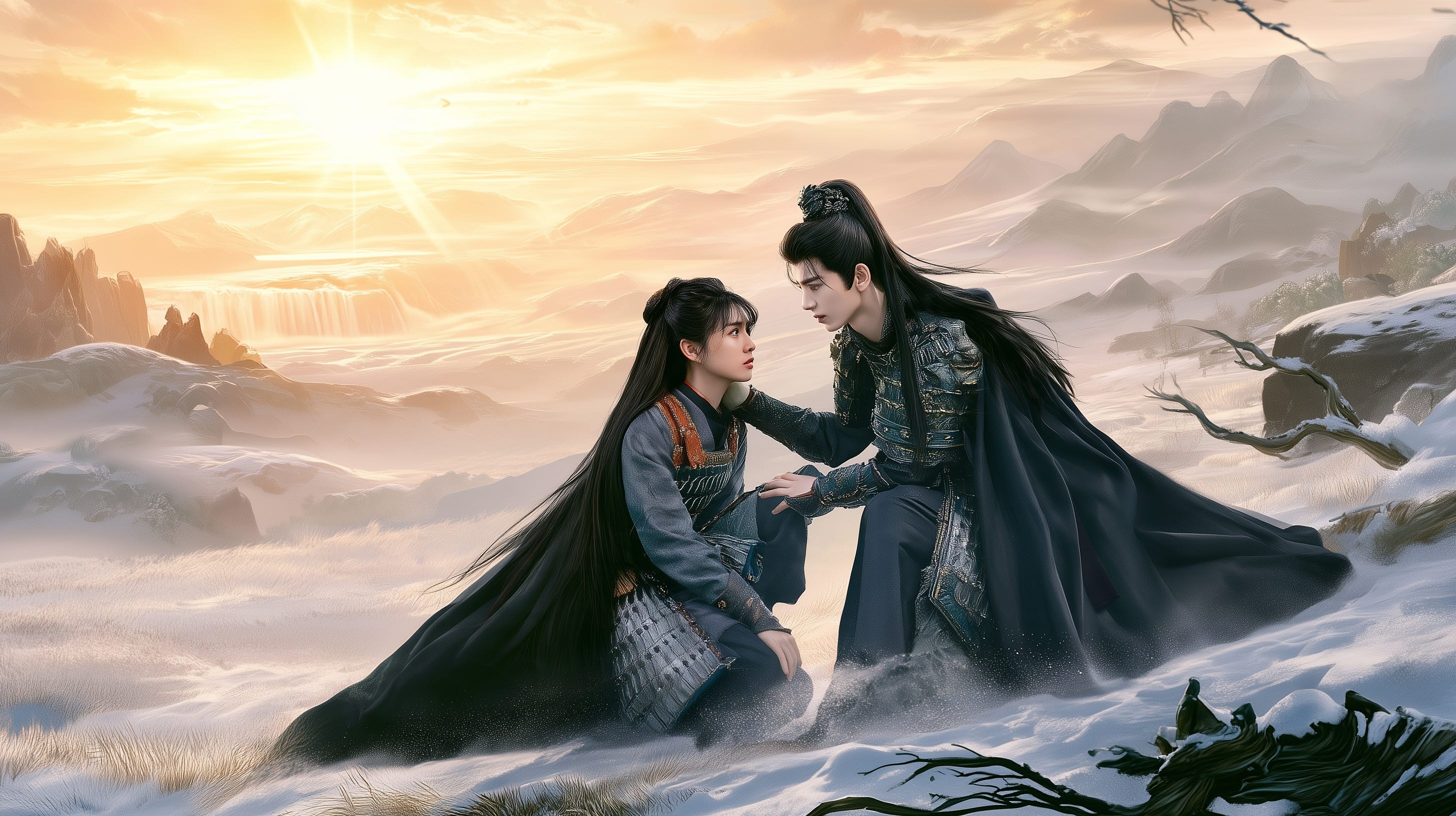
I hung on every episode as Netflix dropped weekly episodes of Pursuit of Jade, the Chinese historical fantasy series that swept the globe and became an international sensation.
The series follows Fan Changyu, a young woman who has taken up her father’s craft as a butcher shortly after her parents’ untimely death. Over 40 episodes, we watch as she rises up from her humble beginnings, caring for her younger sister, saving the life of an errant warrior, and even surpassing his fighting skills to defeat her enemy and demand justice for her parents by the blade of her butcher’s knife.
Like many Chinese fantasy shows, it is a masterclass in aesthetics, with wooden bridges arcing over koi ponds, red lanterns painting the night sky with a glow, and whimsical costumes that swirl artistically as they fight. It is also a masterclass in Chinese philosophy: the slow strokes of the calligraphy brush, the ritualized tea ceremonies, the Daoist virtues of a slow pace of life. And just like every Chinese fantasy series I’ve watched, it makes a powerful political statement as young woman saves her provincial town from the tyrannies of the ruling class.
As I’ve watched so many fantasy series coming out of China, I couldn’t help but wonder: How was China, of all places, putting out much more empowering female characters than anywhere else? Certainly more than Hollywood. And how was a nation of authoritarianism and censorship defeating totalitarianism over and over again in its epic fantasy series?
Because the internet made it possible to read stories that came not just from the state, but from each other. Because young girls started writing fantasy novels for their friends online, and in a country with thousands of years of history and philosophy worth reviving. And because when censorship tries to take you down, the best way you can fight back is with fiction—by reinventing history, or asking for the world we want through the immortals of mythology rather than the political nonfiction of our time.
Fantasy c-dramas have become, not just a beautiful literary genre, but a philosophical and political movement imagining better future through some of the most utopian stories of our time.
Web novelists are re-writing history
It all started in 1999 when an anonymous webmaster known only as sunrain began publishing pirated books on a local government web portal in Jinjiang, a city in the Fujian province of China. These weren’t just any books, but highly coveted romance novels from Hong Kong and Taiwan.
After a 1949 crackdown on a centuries old tradition of romance literature—Mao decreed that all literature must serve a political or utilitarian purpose—the most famous writers fled the mainland. Existing novels became coveted possessions, copied by hand and passed woman to woman in an underground literature circuit. By the 1970s, women caught reading hand-copied romance novels were convicted of hooliganism and sent to reeducation camps.
It wasn’t until the introduction of the internet that cultural shifts began to erode that policy. As Guobin Yang documents in The Power of the Internet in China, people entered forums and created online homes with an excitement for a place they could finally express themselves, something they couldn’t do at school or work. Internet friends became more real any other, because anonymously they could share the likes and interests they couldn’t in real life.
In was into this world that sunrain began scanning censored romance novels and publishing them online. Until, that is, she left for another job in 2001. After six months with no content, a longtime reader posted “The Save Jinjiang Plan” outlining ways the community could revive the site from the bottom up. Sunrain offered up the server’s administrative password, and another user, iceheart, volunteered to take over. Several others offered to help with data entry and proofreading.
Jinjiang began publishing pirated romance novels again, but this time as a volunteer-run organization. When the government server dissolved in 2003, iceheart, who was actually the economics student Huang Yanming, asked for donations so that the organization could buy their own server and relaunch independently. The crowdfund raised 39,000 yuan from readers around the world, enough to relaunch on August 1st, 2003 with two sites: jjwxc.com, the library of pirated romance novels; and jjwxc.net, a new site where readers could self-publish novels of their own.
Jinjiang readers had been consuming romance novels on the site for four years, now they could try their hand at writing their own, and readers responded with lengthy comments about how they could make them better. The content became fine-tuned for what Jinjiang readers came to expect—strong female heroines, a slow burn romance, beautiful settings, and a feminist perspective. Time travel was a particularly popular genre—known as transmigration—with modern women traveling back to the Qing era where they could rebel against the toxic masculinity of history without needing to say it out loud about modern times.
As Jin Feng put it in Romancing the Internet: Producing and Consuming Web Romance, time travel gives writers “license to fantasize about, replicate, and promulgate their particular utopian vision of the world. Modern Chinese women can thus enter a world more ideal than the one they have to inhabit and endure... and enjoy the freedom to reimagine femininity and masculinity.”
That same year, six young men, including a user known as “Heart of Darkness,” launched a competing site for male-oriented fantasy, and this one turned out very different. To start, Qidian was driven by profit rather than peer reading, and writers optimized for what men would pay for: male protagonists, an enticing hook that would get readers to pay for the next chapter, and the hero’s never ending quest to “level up”—cultivating hidden powers and strengths and humiliating his rivals as he gains status and recognition and accumulates a harem of women along the way.
Chinese web fiction was thus split by gender right from the start: one platform for a female audience with a female founder focused around romance and feminism; the other for a male audience with male founders focused on power consolidation, the climb to status, and concubinage.
Very quickly, both platforms became web fiction powerhouses, but with very different trajectories.