


This is a guest post by Spencer Chang for Internet Sovereignty, nine writers exploring the future of the internet through an online essay collection and print pamphlet. Support the series by collecting the digital or print pamphlet. 👇🏻

There’s a Japanese proverb that goes 一期一会 (Ichigo ichi-e), which literally translates to “one time, one meeting.” But in practice, it’s used to capture how every particular moment and gathering only exists once in a lifetime. Striking up a conversation with a stranger on a park bench, making eye contact with someone on the bus, even hanging out with friends in the park on a random afternoon, are all once-in-a-lifetime events.
In 2026, people are going offline as much as possible—I think, in large part, to reclaim this feeling of preciousness around life. They’re chaining their phones to their walls, starting movements to touch grass, and creating entire product lines around reducing phone usage. In the face of a hostile internet, abstinence has become the mainstream accepted response. We crave the spontaneity we know to be in the physical world.
I don’t blame them. The Internet looks quite grim these days. Dead internet theory, stating that the internet is being overtaken and, eventually, will only be inhabited by bots, is entering mainstream discourse as AI social accounts multiply and compete for what flavor of slop comes after Italian brainrot. People are arguing with fake people, and creators have to clarify that they didn’t use AI to make the work they share. Culture commentators are writing about the death of the open internet as people retreat into dark forests, private spaces like group chats that are hidden from the web.
The Internet has lost its innocence, and logging on feels like fighting for survival.
But every once in a while, we still encounter something meaningful that makes it all worth it. Something heartwarming, genuine, inspiring, or joyful that justifies all the hours scrolling and a lifetime chained to our devices. Earnestness shines through even in “content” manufactured for spread.
If dead internet theory posits that the internet will eventually become only bots, alive internet theory proclaims we will never let the open internet die. We will always find a way to look for each other, to answer a call for help, to share a laugh and an argument right after one another. If there’s one trait of the human race that every apocalypse movie agrees on, it’s our will to survive.
We still have hope for the Internet because deep down, we still believe in each other.
The Internet uniquely brings people together who would have never met in the real world on a global scale. We can connect with others over niche interests while being exposed to a thousand other worldviews. At its best, the Internet cultivates our unique differences and allows them to coexist. Rather than a monoculture, we form a multi-faceted, collective network, interconnected but not forced to assimilate. This pluriverse of cultures breeds other differences, hybrids, and niches to connect over.
I actually rediscovered Ichigo ichi-e on my TikTok feed, in a spontaneous meeting via the algorithm several years ago. From what I can remember, the video featured a creator talking about a random encounter with an old man in Tokyo, how, in under 8 minutes, they shared the different problems their countries faced and uncovered this tangible sense of shared humanity.
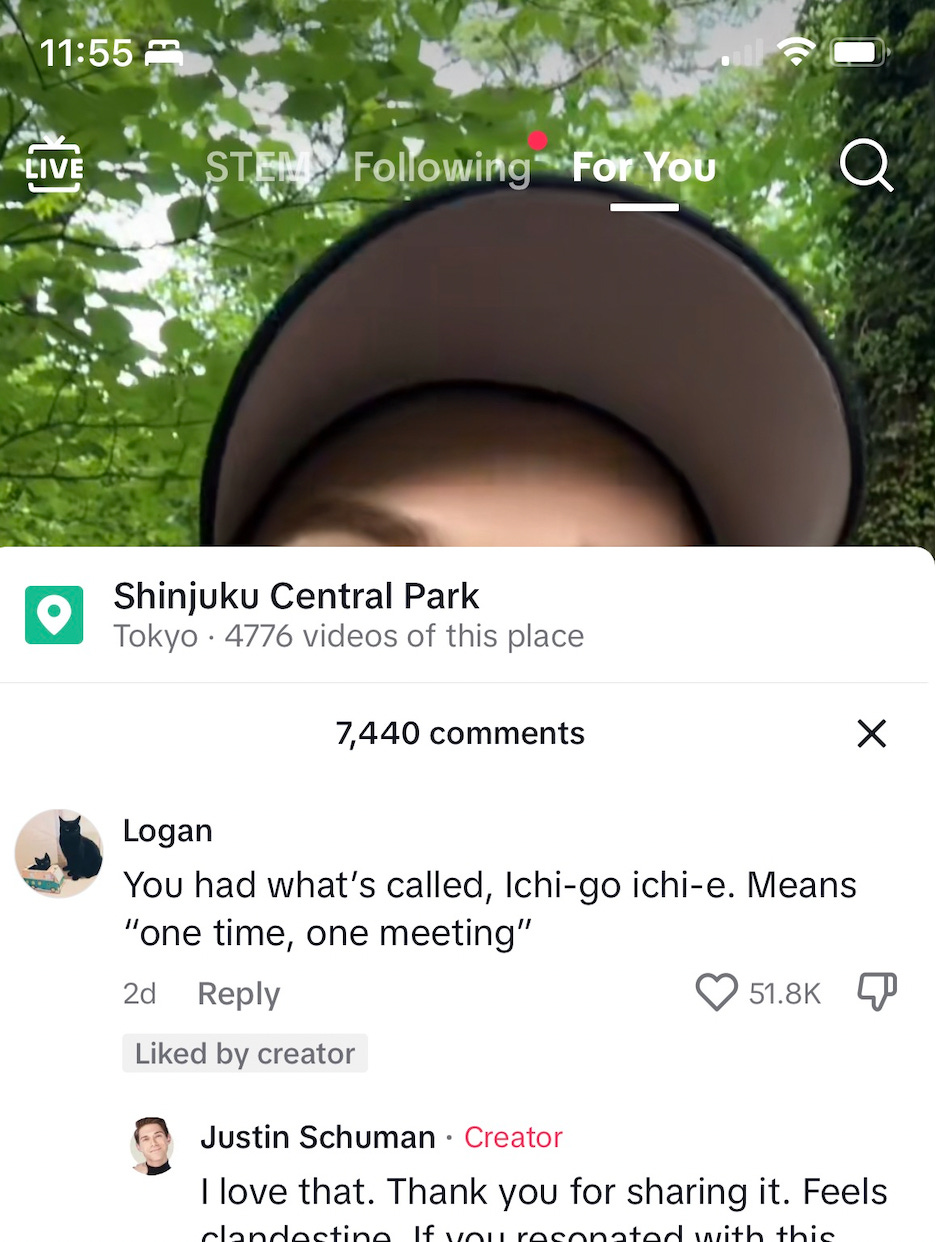
There are two reasons this has stayed with me for so long.
First, it’s a reminder that spontaneity in digital space is still very much possible and can lead to the kinds of encounters that I wouldn’t have the chance to experience through my physical body.
Second, it’s a testament to how deeply we can impact each other through such simple means, and perhaps, the primitive nature of the methods frees us to break past our abstract notions of society to reach a deeper emotional level.
We still live on the Internet, and as long as we do, we can still bump into each other and have these life-changing encounters. But it’s been overdeveloped and undergoverned. Like cities that have prioritized cars over people, visiting the Internet now entails controlled apps and search engines, designed for extraction. There’s nowhere to rest because the benches are covered in spikes. All we can do is sink into the feed and run along the scrollbar until our eyes bleed.
We are all so online, yet being online feels so solitary. Social media is designed for content consumption, brand distribution, and prestige broadcasting, not the warm, funny, and weird moments that happen when humans simply exist together.
We’ve been conditioned to think the Internet can’t be changed, but all our current interfaces—infinite feeds, follower counts, black-box algorithms—are features created by social media platforms to optimize their metrics. Just as they were made, they can also be transformed.
Like guerrilla public improvement projects put benches in public spaces, repopulate foliage in neglected intersections, or transform dumping sites into neighborhood gathering spots, we can also retrofit and reshape our digital space.
So what would an Internet that actually encourages these encounters feel like?
Where can we sit together on the internet? How do we discover a new neighborhood, shelter under a bodega awning during a summer shower, sit quietly at a cafe and work among the chatter of strangers?
Maybe it starts with breaking down the capital-I Internet into several, much-less intimidating tiny internets where we can experiment with new forms of coexisting and relating to one another online.

Rather than a single feed or the same interface copy-and-pasted under new management and brand colors, we might find how people have imagined new ways of living online. Maybe there are no profiles and the feed is a random constellation of images for every minute of the day. Perhaps you have to say hi to five new people before you can write your status. Or you have to go hunting for every new piece of content, pixel by pixel across the screen.
Maybe strangers spontaneously travel through URL rabbit holes together, collectively deciding which way to go next. Meanwhile, others can sit together on the sidelines and watch them bustle.
In my neighborhood internet, I’m a regular at several local spots. I stop by to see the new community chatter, bring a gift or two, and forage for some inspiration from the archives that people have brought back. Some days I travel to other neighborhoods, even new countries, and experience how the culture changes. How do they share their updates? What’s their way of greeting each other? How do they gather inspiration?
We can run into each other
As I run around the web, I spontaneously encounter others in the same places, online together at the same time. I can wave at them, share a warm conversation, play cursor tag, and shake the web page to call others to join us. We share a brief moment of intimacy to honor fate bringing us together.
We can watch each other
Like going to a busy city park and watching the immensity of life unfold, I can take things slow and watch people in their digital pursuits. I can take the scenic path as we travel between links, notice people on their respective commutes and adventures, and get lost in a new place.
We can be remembered
When I visit a website, dig around the links, and leave a note for the owner, the traces of my presence don’t disappear after I leave. Our actions leave a felt mark. This digital patina adds an extra texture to websites, hinting at who has passed through, how frequently they come, and the adventures that have unfolded here.
We can be recognized
In real life, we’re recognized for our faces, names, and styles. In the digital world, we should be recognizable if we meet again, whether it’s the way we move our cursors, the colors we choose, or the marks we make.
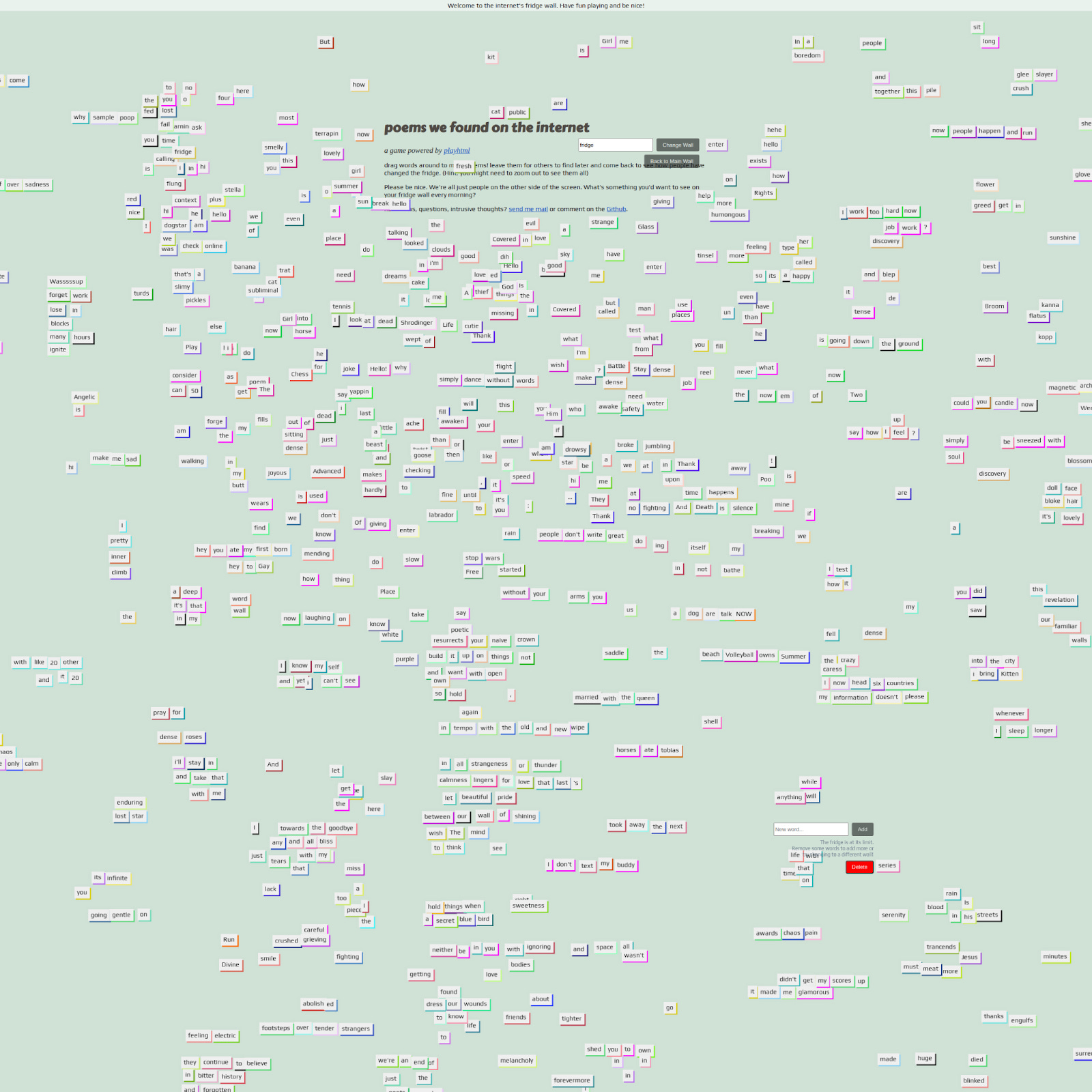
I’ve been experimenting with creating internet neighborhoods of my own, to make poems with strangers, turn the lights off to say good night, collect every color in existence, and grab a drink at the cursor bar after a long day scrolling.
I want everyone to be able to create their own Internet gathering spaces, so I made playhtml, an open-source library for designing communal internet experiences by enhancing web elements with real-time, persistent interactivity. Take it for a spin, and if you need help, remember that I’m just across the web.
Somewhere right now, two strangers’ cursors are touching. Someone is breaking ground on a new piece of the internet for their personal website. Hundreds more are visiting tiny spaces and games to share their feelings with their online family.
The Internet was never promised to be open, free, or modifiable. Born in the U.S. military and courted by several private companies, it could have easily been seized by a single entity. Instead, many brave people fought to keep it open to everyone, collectively stewarded by many, and owned by no one.
We can shape these internets together, piece by piece. We can make our own public parks, cafes, bodegas, waterfalls, and mountains. We can take care of them, not as users, but as stewards maintaining a home for generations to come.
These internets won’t be an escape from the real world. We’ll go offline to touch grass, hang out with friends, and then come back online to find friends and strangers a world away, meeting for a brief moment. One time, one meeting. 一期一会.

Every line I read invoked vibrant images of little corners on the internet that we could call ours. Now this is the kind of digital life to look forward to 🫶🏼
Thanks for this. I've bookmarked your site and want to try some of your tools on one of my websites when I get the chance.