

This is the introduction to the third annual print volume of my work. Paid subscribers at the Collector tier will receive their book in January.
In May of 2024, my husband quit his job for an 18-month sabbatical—the period of his noncompete agreement in his industry—and we took off to travel the world. We spent the summer traveling through Europe—Portugal, Spain, France, Italy, England—then an extended van trip through Denmark, Sweden and Norway. In the fall, we backpacked through Indonesia, Singapore, Malaysia, Cambodia, Vietnam, and Thailand. Then we flew to New Zealand and Australia for the winter, and spent three months traveling through Japan in the spring.
When we came back to the US, it was to be with family—my sister had a baby we were excited to meet, and my other sister had her kids out of school for the summer. We didn’t make it home to Salt Lake City until August of 2025, and by then the America we had left had seismically altered. The election of Donald Trump as our president saw rapid change and polarization hit our country. Even abroad, everyone we met couldn’t stop talking to us about Trump (and Elon Musk). At one point, we attended a comedy club in Sydney where, upon discovering our country of origin, the comedian roasted us for half an hour.
It was a dream year personally, but my writing suffered. I wrote some of my best work, at first—my Mondragon essays appeared in a previous Elysian Volume—but after the election, the times began to radicalize me. The world quickly shifted into a period of inflection, and it lit a fire under me to crowdfund a new book project,We Should Own The Economy, and launch collaborative print pamphlets on governance (CITY STATE) and the environment (TERRAFORM). A grant from O’Shaughnessy Ventures further propelled me forward.
Suddenly, momentum for my business was at an all-time high, but my confidence in my work had reached an all-time low. I had become too hyperfocused on the politics of the moment—too reactionary in face of the headlines. I lost my idealism as I grappled with our times and struggled to find an innovative path through them. I became unsure of the best use of my words: Am I the voice of reason fighting for peace between parties? The rebel fighting for change against political adversaries? The naive artist continuing to harbor utopian ideals while the world burns? I published fewer essays than usual, and fewer that I was proud of. The utopian novel I thought I would write quietly from Kyoto was shelved.
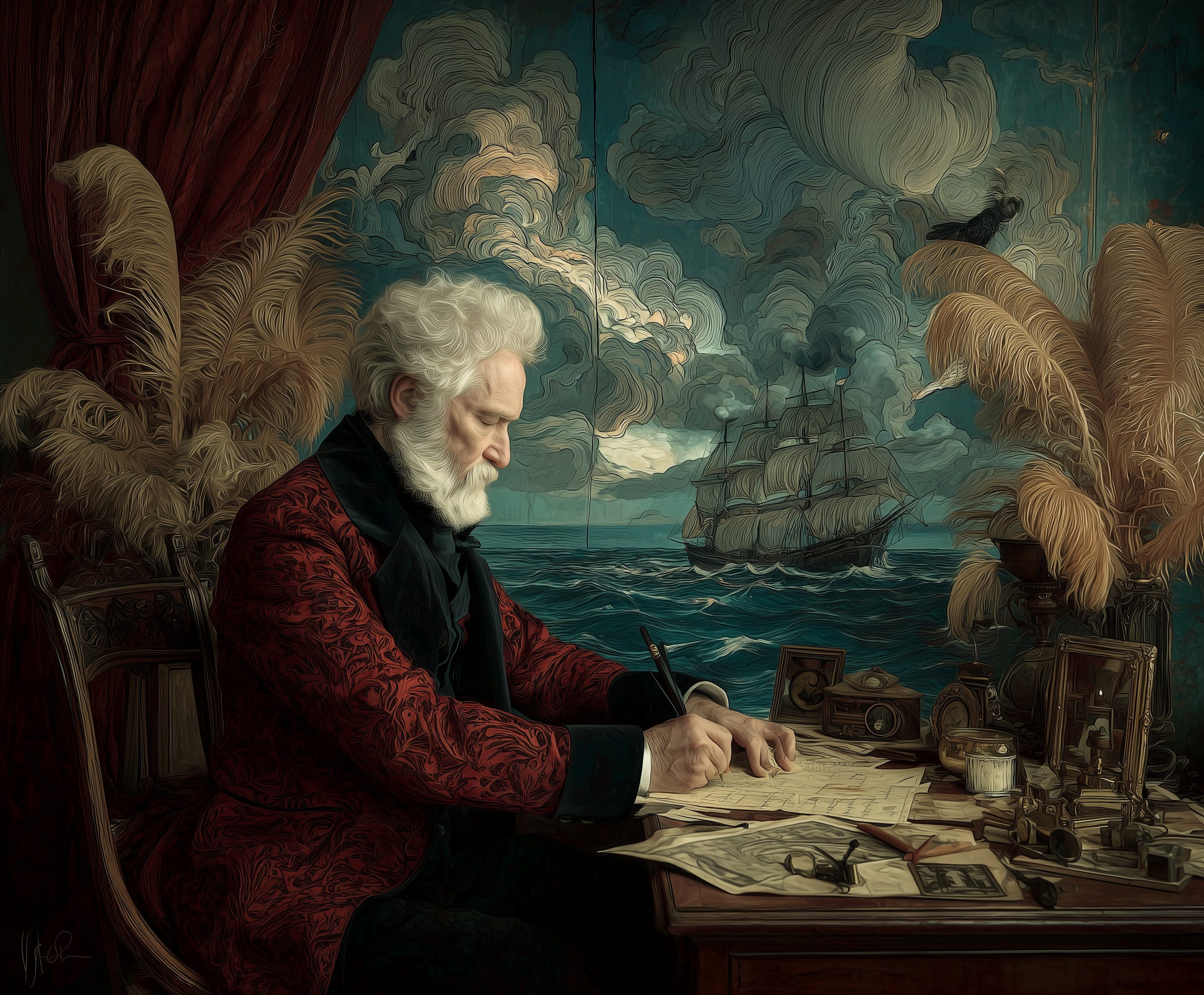
In my artistic crisis, I fled to Victor Hugo’s Les Châtiments for guidance. My favorite author wrote poetry and plays, at first, during the relative calm of the Bourbon restoration. But as the monarchy wore on, he found himself longing for the liberties of the revolution that once overthrew it. In 1831, he published The Hunchback of Notre Dame and became a figurehead for liberal romanticism, a revived artistic craving for “liberté, égalité, and fraternité.” He was an idealistic 20- and 30-something then, with political ideals and a penchant for poetry.
Hugo supported the return of Louis-Napoléon Bonaparte, at first, believing he would restore democracy to France. That is, until democracy died beneath his heel.
When Louis-Napoléon crowned himself Emperor Napoléon III, Hugo fled the country and spent decades railing against the conqueror with all his literary might. From his island apart from France, he penned political pamphlet after political pamphlet, and in 1853 published Les Châtiments, a book of verse devoted to canceling the emperor. His writing went from prose to moral weapon, his role as a romantic turned to radicalized political exile.
Even in his scathing condemnation of tyranny, however, his writing came out in poetry.
“They’ve overthrown Rome; would have destroyed Sparta.
Yet these fools are charmed by Monsieur Bonapart-e…
You senators, judges, lords, generals—you princes,
You—Caesar, adored by your kneeling provinces
You who dreamed Empire—your dream’s now complete,
Sleep, masters— It’s day! Prisoners, on your feet!”
“Tell me why did they kill him?— it hurts me to speak—
This child never shouted “Vive La Republique”
Hugo was 49 years old when he fled to Guernsey, and 60 by the time he published the masterpiece that is Les Misérables. He didn’t return to Paris until Napoléon III fell in 1870, and by then he was nearly 70 years old. His novels would be translated around the world for all to see but Les Châtiments would die in obscurity, the scathing remarks of his political times never translated into English and only readable by me because a blogger once half attempted it.
I am 40 years old now. I may live to see an emperor at 49 as Hugo did, I may not, but there can no longer be any doubt that my times will see great change, and that my writing will change and adapt with it. I may be radicalizing as Hugo was, I may have forces to rebel against as he did, and I have my enemies—like Hugo they are tyranny, oppression, inequality, and ignorance. But I’ve learned from his work, and I have no intention of allowing mine to be swallowed by everything I hate about the world. Being a romantic means also finding something to love. It’s uniting around ideals worth working toward—beauty, freedom, truth, and love!
I’ve been feeling my way through these times, writing essays I like and essays I don’t, changing my mind constantly as I gain new perspectives and try to understand my voice in it all—often trying, and failing, to not get sucked into the turmoil. But, in this annual collecting of my work I am reminded that, for better or worse, I am an artist first and a journalist second. Though, like Hugo, I have written blithe novels during times of peace and scathing journalism during times of trial, this is the year I fling myself firmly into the arms of the romantics—to take this as an opportunity to unite us around ideals, and be inspired to create what comes next.
I am back at my desk and motivated to write some of my best work—a book, collaborative pamphlets thinking through some of the most important ideas of our time, a utopian novel. I’m all too aware of our times, but I will not dwell on them. Instead, I will use art to get through them, and to find a way out of them! There are many who can cover the political minutia better than I, and I’d rather focus my time elsewhere. My work doesn’t lie in the trenches, it lives out on the horizon.
If Victor Hugo can write satire and prose through the revolution, so can I. Even then, it will be the work that unites us around something better that will continue to inspire us for centuries to come, and that’s what I plan to focus on from here.
As Hugo said in Les Châtiments:
Art makes the enslaved free
The free it makes great!
Thanks for reading,
Elle Griffin
Thank you for this! I’m living in the USA this winter after living abroad since 2010 and you just put into words so many things I’ve been feeling but haven’t understood (everything changed when Trump was re-elected, but since I missed the first term it’s like I couldn’t quite sink my teeth into why this felt *different*)
Thank you!
This reflects something I’ve experienced: the times change the work and the work changes you. And that’s a good thing, or at least a necessary thing. A lot of people aren’t open to being changed in that way, so kudos for that, Elle.