
San Francisco should be profitable—instead property owners are
Or how the Gilded Age screwed American cities and how we can reverse it.
This is part of “Let Cities Build Utopia,” an 11-part series on the future of cities. Collect the complete series as a print pamphlet, digital pamphlet, or audiobook.
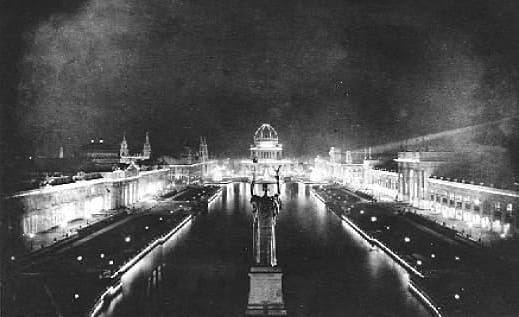
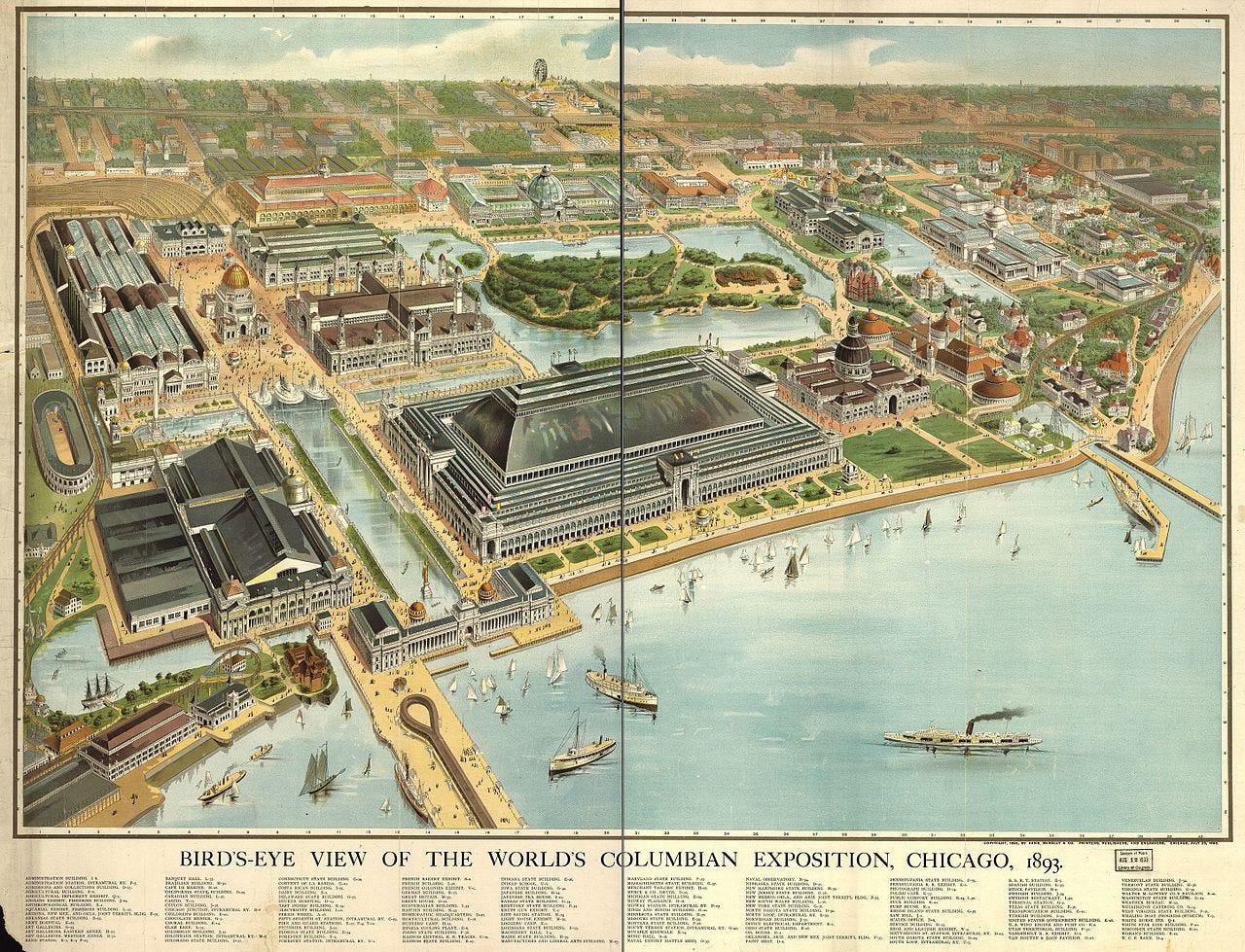
At the same time that Bournville was establishing an idyllic hamlet for factory workers, Nikola Tesla and Thomas Edison were competing to power America’s first urban district: the 1893 World’s Columbian Exposition in Chicago. Tesla won the contract, and when Chicago debuted the fair’s “White City” across the waterfront, it became a spectacle of light. Twelve massive Westinghouse generators powered 100,000 lamps, lighting up canals, plazas, fountains, and buildings. More than 27 million people traveled to see it.
What followed was a revolution in utopian city building, but an altogether different one from England’s. If the European movement was about economic justice and the welfare of the working class, the American movement was more about private property and the aesthetic vision of industrialist capitalists. Developers used steel to build the world’s first skyscrapers, and Elisha Otis invented elevators that would take people to the top. Edison and Tesla powered our buildings, Bell Labs created telephones that connected them, and Ford mass-produced automobiles that allowed faster travel time between cities.
Cities were being improved, not by government reform, but by corporate innovation!!!
By the time the labor movement arrived at the turn of the 20th century, there was a utopian faith that technology, more than politics, would solve worker welfare. American companies were producing washing machines, dishwashers, vacuum cleaners, and refrigerators that promised to liberate women and give them more leisure time. Automobiles made it possible for workers to live in a pastoral suburb far away from the sooty city. Radios and eventually movie theaters made entertainment more accessible to everyone.
Industrialization might have been the problem in England, but it was also the solution in America, and that came with a very different set of ideals.
We can see this contrast plainly when reading two utopian novels of the period, one written in 1888 Boston, Edward Bellamy’s Looking Backward, and another written in 1890 London, William Morris’ News from Nowhere. Both novels imagined the year 2000, but the English one imagines a nostalgic Garden City aesthetic, with tranquil boat transportation, and no factory in sight; while the American one features architectural grandeur, music piped from central orchestras into every home, and Amazon-like warehouses providing for our every need.
If London dreamed of an anti-factory, anti-metropolis, pastoral paradise, Boston dreamed of a pro-progress, post-scarcity, techtopia!!!
My great-grandfather spent 50 years inventing lightbulbs for Edison and my family still has his paychecks, signed by Thomas Edison, hanging on our walls—it’s his wife’s wedding ring I wear. There was a mythos then, passed down to us today, that Americans could create a better future with our own ingenuity—with companies and research labs and governments that funded innovation rather than social welfare. Even after the Great Depression hit, the government used its money to fund ambitious highway projects, the Hoover Dam, and the Golden Gate Bridge—feats of engineering and skill that would keep people employed, rather than housed. At the 1939 World’s Fair in New York, General Electric debuted Futurama, a near future model city with a vast highway system, automated cars, and modern cities.
These ideals bettered American lives, but they didn’t build better cities.
There was some interest in the European models in the US. Bournville and Port Sunlight were widely reported on in the press, and a few American capitalists were inspired by their “welfare capitalism” mission. Milton Hershey, for one, built a chocolate town in Pennsylvania where he established a school that, to this day, owns a controlling stake in the chocolate company and a share of the profits. (If you’re counting, that makes three philanthropic chocolate towns in our story so far).
Ebenezer Howard even had a contemporary in the American Frederick Olmstead, who traveled to England to study the company towns; then returned to design parks systems for Boston, Buffalo, Louisville, and Seattle; and eventually helped found the National Park Service. He even designed the landscaping for the White City, and his sons went on to design America’s version of Letchworth: The philanthropist-funded towns of Forest Hills Gardens, New York; Marimont, Ohio; and Torrance, California.
Unfortunately, every town built by capitalists and investors in America were eventually sold off as private property, not held in common by a trust. And this would become a recurring theme.
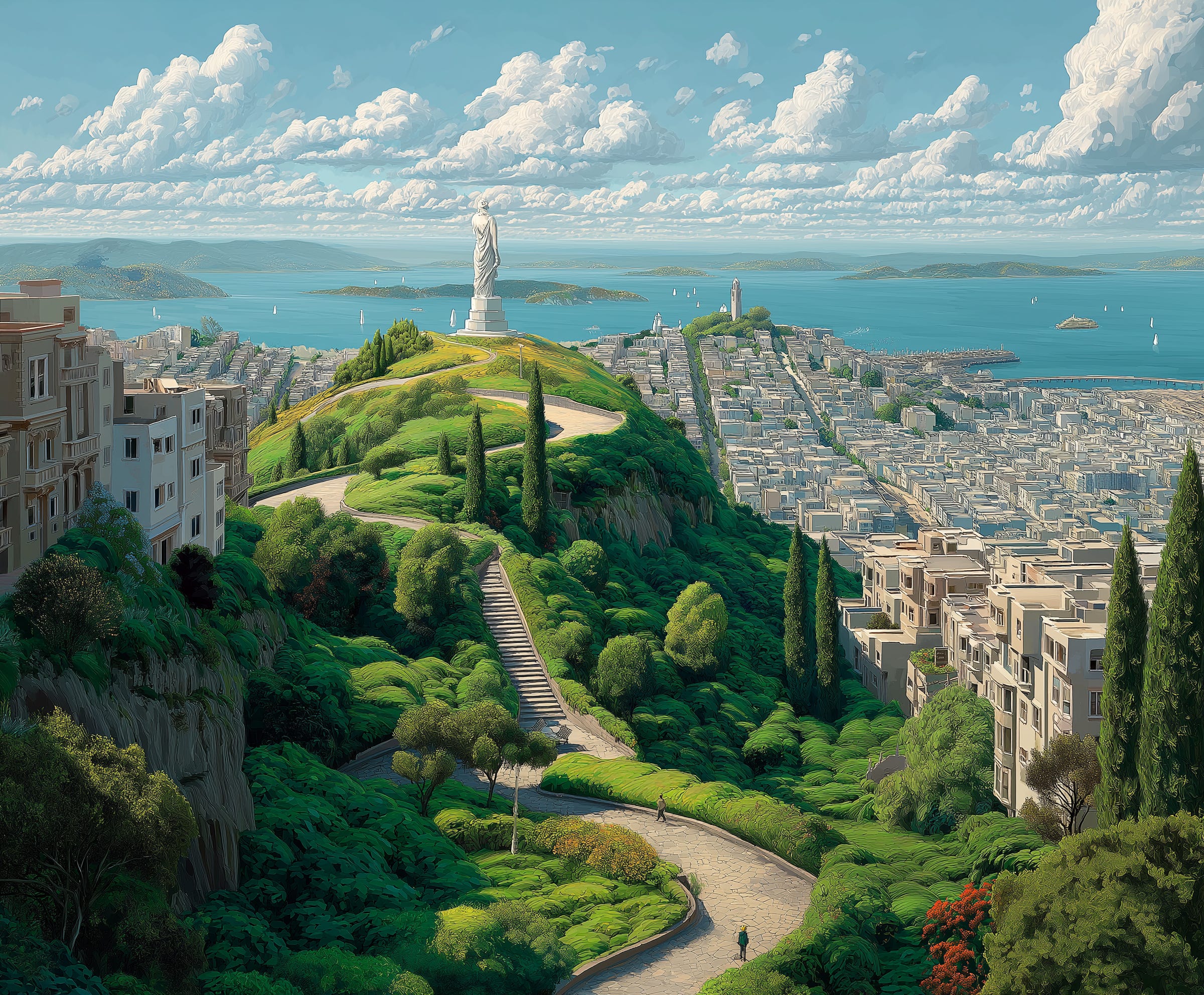
After the success of the White City, the exposition’s designer, Daniel Burnham, became the poster boy of a new city revival movement—dubbed “City Beautiful”—and was inundated with requests to design the Washington Mall, as well as the cities of San Francisco, Chicago, and Cleveland. His 1906 plan for San Francisco was one of the first master-plans drawn up for an American metropolis, imagining the city as an epicenter for arts and culture, with a third of it reserved for parks, and an Athenæum in the hills with a monumental statue looking out to the water!


His 1909 “Plan of Chicago” featured wide boulevards, a walkable city center, and a public promenade along the waterfront. He thought modern sculptures and architectural marvels, as found in the ancient cities of Paris or Rome, would set American cities apart from the rest of the world, and that walkable city centers surrounded by nature would re-create the paradise so loved at the Exposition. “The Lakefront by right belongs to the people,” Burnham wrote in his plan. “Not a foot of its shores should be appropriated to the exclusion of the people.”
I read both plans in their entirety—the Chicago plan is massive, with plans for every street and block, and comprehensive plans for public transportation systems and funding. Hundreds of municipal agencies met with Burnham weekly for more than 18-months to build it.
None of Burnham’s city plans were built.
Chicago didn’t have one planning authority, but hundreds of municipal governments and committees, which themselves had to report to a web of state and legal jurisdictions. And the city didn’t have one land owner, but thousands of property owners with competing interests. Chicago would have had to purchase massive amounts of land using eminent domain to make Burnham’s plan happen, and no municipal entity had that kind of power, much less the tax authority to raise funds to do it.
After the 1906 earthquake destroyed 80% of San Francisco, the city had the opportunity to build Burnham’s plan from scratch, but couldn’t take it. Property owners wanted to recoup their losses now, and weren’t about to let the government delay their projects or take over building. The Southern Pacific Railroad controlled land downtown and had no interest in using it for Burnham’s plan. The city was held hostage by private property owners who wouldn’t give a single inch for the sake of master-planning utopia.
Here, we must remember, there was an inherent distrust of the government. Many Americans crossed the Atlantic to get away from more oppressive European ones; they weren’t about to hand power to a central authority. If European socialists thought governments should own land on behalf of individuals, American capitalists thought individuals should own land without government intervention, and that produced very different societal results.
American cities grew rapidly, which meant property owners got rich quickly. The frontier became a wild west land grab, with wealthy industrialists buying up land in the cities and railroad barons buying up land along the train routes. Land became scarce and expensive to buy, and cities wound up with lots of empty lots they couldn’t build on. Workers in San Francisco or New York might live eight to a flat while the neighboring lot was empty, the private investment of some American capitalist.
It was in this vein that Henry George proposed a land rent model more favorable to Americans: In his 1879 book Progress & Poverty, he advocated, not for government-purchased land, but privately-owned land that was taxed by the government to fund social welfare. Specifically, he thought only the unimproved value of the land should be taxed. That is: An empty lot in the middle of San Francisco is worth more than an empty lot in the middle of the desert, and thus should be taxed more. No individual made that land more valuable, society collectively did, and thus no one individual should benefit from that land, but society collectively should.
This was different from how property taxes in the US and ground rents in England worked at the time. Both taxed a property’s total value, including any buildings on it. If property owners developed their land or otherwise improved the buildings on it, they would pay much higher taxes for increasing the value of their property. This penalized growth and development, and created an incentive for speculation, with private land owners buying up property and sitting on it for decades as an appreciating asset.
George thought we could fix the problem, not by taxing development, but by taxing the full value of the land beneath it. That is: If the land (without buildings) would rent for $1,000/month, then the landowner would pay $12,000 in taxes each year. That might sound high, but homeowners and commercial developers would benefit from this transaction—taxed only on the value of their land, not buildings too. And both could build whatever they wanted on that land untaxed, with unlimited earning potential. It was only the speculators who were penalized—it would be too expensive to sit on vacant land, and thus property owners would have to do something productive with it or sell it to someone who would.
The city, meanwhile, would earn much more income as it grew.
Imagine how rich San Francisco would be today if it earned rent on all of its land each year. The answer is: Very rich.
George believed these taxes should go to the city—not to state or federal governments—and that’s already how taxes worked back then. In the early 1900s, cities were funded with property taxes, states were funded by multi-city infrastructure projects like railroads, and there was no income tax yet—the federal government was funded only with tariffs and consumption taxes on alcohol and tobacco. George’s land tax then, was not a revolution but a minor reform to the way cities were already funded. He even thought we could replace all of the other taxes with just this one, a single tax that didn’t penalize American industrialism or capitalism, just the unearned value of the land beneath it.
George’s book became a bestseller, and his idea for a single land tax—called “Georgism”—was immensely popular. But governments didn’t adopt it. America was entering its Gilded Age, and the country’s largest landowners weren’t about to allow their investments to be taxed so highly. They branded George a “socialist” even though his plan preserved private property. They martyred him as a “tax the rich” radical, even though his plan wouldn’t tax their wealth or assets, just the land that owners did nothing to improve. When George ran for New York City Mayor, campaigning on a land tax that would fund the entire city, real estate owners threw all their weight and money behind his opponent, who would do no such thing.
Indicative of the movement, a board game invented to teach Georgism in 1904, became “Monopoly” when the Parker Brothers licensed it. In the original game, players paid rent into a public treasury that benefited all players. This was meant as a cautionary tale against the other way it could go: With one landowner buying up all of the property and extracting rent from the rest of the players. When Parker Brothers developed it, obtaining a monopoly became the goal of the game, not the path to avoid.

By the early 1900s, the Gilded Age had reached its height, and workers were destitute and striking. Then, as now, the cities leaned liberal. Workers lived in the cities, which meant cities were where the unions formed and the socialist movements rose. George’s run for New York City mayor served as a close call for conservative landowners in the suburbs. If they didn’t want their assets taxed (or worse, appropriated), they needed to take power from the more liberal cities.
In 1907, the US Supreme Court passed Dillon’s Rule, giving states authority over cities and taking away their ability to levy taxes, capture land rents, and establish welfare systems.
Georgism was effectively dead.
Except where it had been enshrined in trusts.
In 1894, the Fairhope Single Tax Colony had been founded by Georgists in Alabama, and in 1900 so too was Arden, Delaware. Both towns held land in common and earned land leases that they recycled into the public good. These towns were closer to England’s company and philanthropist towns than George’s own ideals—residents still had to pay taxes to the city and state—but they continued to prove the land rent model could fund cities.
And that trust ownership was the only way cities could survive the whims of politics.
By the early 1900s, wealth inequality had reached its breaking point and progressive reformers like Theodore Roosevelt and Woodrow Wilson advocated for a national income tax instead. This became a populist rallying cry. When America passed the 16th Amendment in 1913, giving Congress the ability to establish a national income tax, it was a tax on the rich. Ninety-seven percent of the country paid no tax at all, while the highest earning brackets paid 7%.
As in Europe, tax rates were subject to politics. The top marginal rate increased to 77% when the Fed needed more funds for war and fell to 25% under conservative parties, only to rise back up to 63% after the Great Depression. By 1943, World War II was on our doorstep, and the federal government passed the Current Tax Payment Act to fund it. What was once a tax on the rich now became a tax on everyone—80-90% of Americans now paid income taxes, instead of just 3%.
After the war, America never went back.
There were a lot of good things about the federal income tax—for one, it funded social security in 1935—but the 16th Amendment radically reshaped the United States. Cities, which were once the richest and most powerful entity in our lives, were now poor, with little power of their own. The federal government, which was once small and tariff-funded, was now large and wealthy. Though Americans once prided themselves on being a nation of independent colonies, now they had achieved the opposite: A large centralized government with sole power over the coffers.
The contradiction is that cities are our most productive entity, but also the poorest. Cities are rich in GDP, but poor in public goods. Most of the money we make still happens in cities, and most of the services we need are still local ones—hospitals, schools, day cares, libraries, retirement homes—the kind George and Howard wanted each city to be able to self-fund. Instead, the bulk of our earnings, and thus powers, are given to the federal government, and we’re left to fund local resources with dwindling state budgets and private spending.
To this day, San Francisco can’t build housing—it doesn’t own any land. And it can’t build new trains whenever it needs them—transportation money comes from state and federal grants, which must approve every expenditure through years of state and federal compliance. San Francisco can’t even hire enough police officers—the city is short 500 officers—because private property has become too expensive to attract them into the city. Since the cost of housing is so high, so is homelessness and street disorder.
As a result, San Francisco is far from a utopia. For being America’s most future-thinking city, it is also its most dystopian, with aging buildings and infrastructure, stores that have locked down all their merchandise because of rampant shoplifting, and the terrible reality of having to step over people sleeping in their own urine on the sidewalk. I spent a decade living and working in the Bay Area—nowhere else in the world have I had someone spit on my jacket as I walked by, or throw a brick at my car while I was at work.
San Francisco may be full of people building inspiring things, but every investment in the city only improves land values that the city cannot capture.
Gains flow to private landlords, not city residents.
Despite every attempt at master-planning utopia, the Washington Mall was the only place where one of Burnham’s plans was implemented in its entirety. Washington DC is not just a city, but also a state, and thus owns its own land and can use its own tax dollars to build whatever it wants without private property owners or competing city or state governments compromising them away.
This is part five of an essay series titled “Let Cities Build Utopia.”
« Click to read the previous installment // Click to read the next installment »
Special thanks to the Center for Land Economics who supported this series as a patron. I highly recommend their newsletter “Progress & Poverty,” which was invaluable to my research.


I'm no economist and perhaps not entirely following your thoughts correctly, but San Francisco has taxpayer budget of $16 billion a year, the highest for a city its size in the world. Compare this with Paris, for one example, with a population about 2.5 times the size of San Francisco with a budget that is billions less. Plus they get the Metro thrown in. It seems to me that even if the city could double that, it would still be dysfunctional on the levels, the schools, street vagrants, and public transport foremost.
Thank you, I am really enjoying this series. And by coincidence also reading Morris’s News from Nowhere this week. I’ve never thought to compare what was happening in London at the time with Boston. This is very helpful.